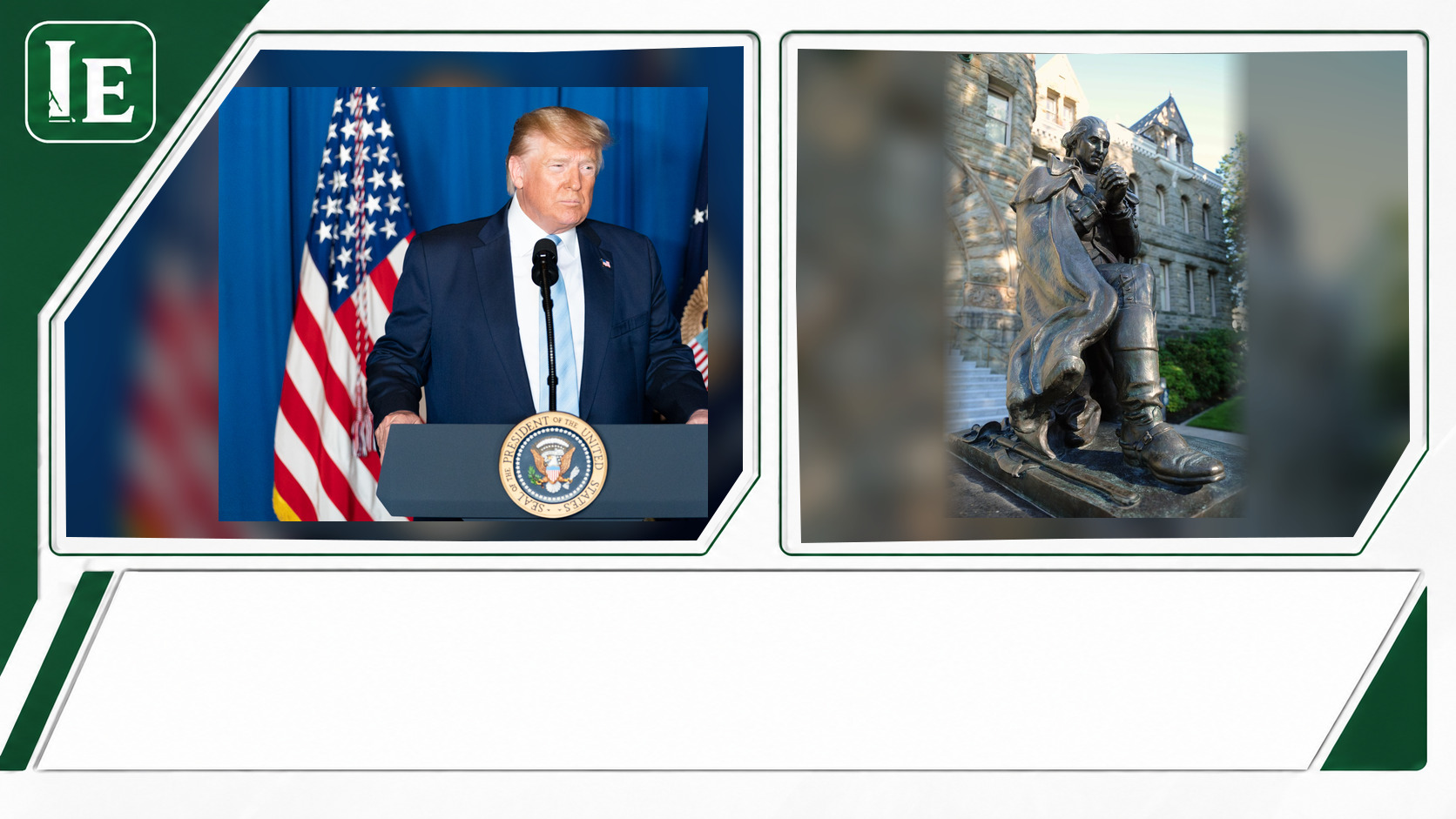
A post featuring an AI-generated George Washington was more than an offbeat social-media moment. It arrived as Trump continued promoting a proposed White House ballroom that remains politically contentious.
Donald Trump posted an unusual AI-generated video involving George Washington on August 16, 2026, thanking “George” for ideas about a proposed White House ballroom. The post, reported by MEAWW News, showed Trump and Washington inside a virtual version of the $400 million project Trump has continued promoting.
The unexpected turn was the identity of “George”: not a current adviser or donor, but an AI-rendered version of the first president. The joke-like video also put fresh attention on a project that, according to the report, still requires approval before it can be built.
George Washington becomes the pitchman
Trump’s message was unusually specific. MEAWW reported that he wrote, “Thank you, George, for some of your brilliant ideas on this great Military Complex/Ballroom!”
In the video described by the outlet, Washington stands beside Trump as the two tour an elaborate ballroom that exists only as a digital creation. That is the central oddity of the post: a long-dead president is presented as a collaborator on a modern White House proposal.
The premise may have been intended as humor, spectacle or both. But it also does something more practical for Trump’s message: it turns a technical construction and approval dispute into a highly shareable visual.
The project is bigger than a post
The proposed ballroom is described in the source report as a $400 million construction effort. MEAWW said Trump is seeking permission from the Supreme Court to move forward with it, although the report did not provide a court filing, docket number or a direct link to a government announcement.
That distinction matters. The video depicts a finished interior, while the report says the project does not yet exist. One social-media caption quoted by the outlet referred to a “new White House ballroom” as being “under construction,” but that characterization conflicts with the article’s own account that permission remains unresolved.
For readers trying to separate the post from the proposal, the clearest takeaway is that the video should not be treated as evidence that the ballroom has been approved or built. It is a visualization of what Trump wants to create, based on the available report.
Why the AI format changes the story
Political figures have long used renderings, ceremonial backdrops and historic imagery to sell big projects. AI lets that approach become more personal and less formal: instead of a blueprint or architects’ presentation, Trump can appear to receive enthusiastic advice from George Washington.
That format blurs several lines at once. It blends satire, promotion and an imagined historical endorsement, while giving supporters an easy object to celebrate and critics an easy target for ridicule.
Eric Daugherty of Right Line News shared the clip on X and called it “awesome,” according to MEAWW. Political commentator Brian Krassenstein took the opposite view, calling the post evidence that Trump had “completely lost [his] marbles.” MS NOW host Eugene Daniels, the report said, expressed uncertainty about what the video was meant to be.
Those reactions reflect the larger divide around the clip. Supporters can see a playful, attention-grabbing defense of a presidential vision. Critics can see an extravagant digital promotion for a project whose public justification, approval path and ultimate cost warrant scrutiny.
A ballroom raises public questions
The unusual Washington cameo may dominate the conversation, but the more consequential issue is the proposed construction itself. A $400 million White House project invites questions about how the estimate was calculated, what changes it would make to the complex, who would oversee the work and what legal authority supports it.
The source report characterizes the effort as controversial, yet it leaves several basic points unclear. It does not identify the expected funding source, the architectural plan, a construction schedule, or the precise lower-court or agency action that prompted a Supreme Court request.
Those gaps do not prove that the proposal lacks a plan. They do mean that a polished AI tour offers far more detail about the imagined look of the ballroom than the available reporting offers about its real-world mechanics.
For a project tied to the White House, where changes carry symbolic as well as practical weight, that imbalance is likely to keep driving debate. The building is not merely a venue; it is a public landmark and the seat of the presidency.
The post also carried a contrast
MEAWW noted that The Daily Beast criticized Trump’s post by contrasting the virtual ballroom tour with reported conditions aboard the USS Abraham Lincoln. The source said the criticism focused on allegations involving shortages and poor living conditions for sailors, claims that are separate from the ballroom proposal and were not independently documented in the material provided here.
The juxtaposition explains why the video drew stronger reactions than a typical AI novelty. Critics used it to argue that Trump was emphasizing a grand personal project while more immediate concerns demanded attention. Supporters may argue that a social-media post does not prevent an administration from addressing other issues at the same time.
Either way, the clip invited an argument about priorities, not just about technology or historical humor.
What remains unresolved
Trump’s post made the ballroom easy to picture: George Washington appears to approve, Trump supplies the tour and the finished room is already on screen. The actual proposal remains less clear.
Based on the source material, the unanswered questions include whether the Supreme Court will consider or grant the requested permission, how the $400 million estimate would be funded, and whether a formal public plan will be released. The report also does not establish whether Trump or the White House offered a detailed explanation of the video’s intended message.
For now, the George Washington appearance is the attention-grabber. The lasting significance lies in what it was promoting: a costly proposed White House ballroom that has become a political symbol before construction has begun.
Leave a Reply