Category: News

  • House GOP Turns Trump Tax Cuts Into a Safety-Net Tradeoff

    House GOP Turns Trump Tax Cuts Into a Safety-Net Tradeoff

    The vote puts Donald Trump’s domestic agenda into legislative form: lower taxes, more border funding and deep fights over who bears the cost. The policy stakes now shift from Capitol Hill math to household budgets, hospitals and state safety-net systems.

    House Republicans passed H.R. 1 in Congress, and the bill pairs Trump tax cuts with reductions to safety-net programs. The measure advances Donald Trump’s agenda by extending Trump-era tax policy while cutting Medicaid, food assistance and clean-energy spending and adding money for border and deportation efforts.

    The vote matters because it turns a campaign-style promise into a governing tradeoff: lower taxes and tougher enforcement on one side, reduced domestic supports and higher deficit pressure on the other. Republicans call it preventing a tax hike. Democrats call it a rushed redistribution upward.

    A tax bill with sharper edges

    H.R. 1, branded by Republicans as the “One Big Beautiful Bill Act,” is built around a familiar GOP argument: if Congress does not act, key tax breaks from Trump’s first term will expire and many households and businesses will face higher taxes.

    That is the cleanest political sell for Republicans. It allows them to frame the package as tax protection rather than a new giveaway. The bill also includes Trump-aligned tax ideas such as eliminating taxes on tips, a provision designed to appeal to service workers and campaign-trail audiences.

    But the package is broader than taxes. It also channels substantial money toward border security, national security and deportation-related enforcement, tying fiscal policy directly to Trump’s immigration agenda.

    The financing side is where the bill becomes much more divisive. The package relies in part on reductions to Medicaid, food assistance, clean-energy incentives and other domestic programs, meaning the tax-cut extension comes with a clear safety-net cost.

    Why Republicans moved so fast

    The pace of the bill became part of the fight. The source brief describes H.R. 1 moving from a late Saturday Senate procedural cliffhanger to final House passage early Thursday, ahead of Trump’s July Fourth deadline.

    That deadline was not just symbolic. It gave GOP leaders a clock to organize around and gave Trump a way to measure party discipline. For a party governing with narrow margins, speed can be a strategy: shorten the window for defections, amendments and outside pressure.

    According to the Associated Press, Senate Republicans cleared a key procedural hurdle 51-49 after hours of stalled voting and private talks. Vice President JD Vance was at the Capitol in case a tie-breaking vote was needed, underscoring how little margin Republican leaders had.

    Two Republicans, Sen. Thom Tillis of North Carolina and Sen. Rand Paul of Kentucky, joined Democrats against moving forward at that stage. Their objections came from different corners of the party, which is why the bill’s passage is politically revealing.

    Medicaid became the flashpoint

    The most immediate human stakes center on health coverage. The nonpartisan Congressional Budget Office estimated that the Senate version would increase the number of people without health insurance by 11.8 million in 2034.

    That figure gave Democrats their sharpest attack line and created trouble for Republicans from states where Medicaid supports rural hospitals, low-income families, children, older adults and people with disabilities.

    Tillis said he could not support the bill because of what he viewed as grave Medicaid cuts that could leave many people in North Carolina without health care. His position highlighted a practical problem for the GOP: broad promises to cut spending often become politically harder when the cuts are attached to real providers and patients.

    Republicans who back the bill argue that safety-net programs need tighter rules and lower costs, and that tax certainty will help the economy. The disagreement is not simply whether Medicaid should exist. It is whether the federal government should trim health and food supports to preserve tax cuts and fund enforcement priorities.

    The deficit fight cut two ways

    Paul’s objection showed the opposite pressure on Republican leaders. He opposed a provision that would raise the nation’s debt limit by $5 trillion, arguing from the fiscal-hawk side that the bill did not do enough to restrain borrowing.

    That put GOP leadership in a bind. Some Republicans worried the safety-net reductions went too far. Others worried the bill still left too much debt. Trump wanted the package delivered quickly, and leaders had to hold together members who were uncomfortable for very different reasons.

    This is the central tension inside H.R. 1: tax cuts are popular within the party, border funding is politically powerful with the Republican base, and deficit reduction is a long-standing conservative promise. Making all three fit in one bill is harder than campaigning on them separately.

    The result is a package that asks Republicans to accept tradeoffs they do not all like. It also gives Democrats a simple counterargument: the bill extends tax benefits while reducing programs used by lower-income Americans and adding to long-term fiscal strain.

    Democrats attack process and priorities

    Democrats focused heavily on how the bill moved. Senate Democratic leader Chuck Schumer accused Republicans of unveiling the text “in the dead of night” and rushing the measure before the public could fully absorb it. He forced a full reading of the bill, a delay tactic that also emphasized its size and complexity.

    The process complaint matters because large reconciliation-style bills often become magnets for provisions that receive little public debate. The source brief describes a 940-page bill appearing shortly before midnight, with leaders pushing under a holiday deadline.

    Democrats also attacked the substance. They argued that the package protects tax cuts while weakening Medicaid and food assistance. Sen. Ron Wyden of Oregon warned that rolling back clean-energy investments would harm U.S. wind and solar industries.

    Republicans rejected that framing. The White House said it strongly supported passage, and Senate Majority Leader John Thune said it was time to get the legislation across the finish line. To GOP leaders, H.R. 1 represents the agenda voters endorsed by returning Trump and Republicans to power.

    What passage signals now

    The bill’s passage signals that Republicans are willing to spend political capital on a compact version of Trump’s domestic agenda: tax continuity, immigration enforcement, fewer clean-energy subsidies and a smaller safety net.

    It also signals that internal GOP disputes are manageable when Trump is pushing for a deadline and leaders can present the vote as a test of party unity. The late maneuvering, including holdouts and procedural pressure, showed fragility. The final result showed discipline.

    The unanswered questions now are less about the slogan and more about implementation. How deep will the safety-net effects be in states with heavy Medicaid reliance? How will hospitals, food banks and state agencies absorb changes? Will the tax provisions produce the growth Republicans predict, or will deficit concerns intensify?

    H.R. 1’s political meaning is already clear. It forces a choice Republicans were eager to make and Democrats were eager to spotlight: extending Trump tax cuts while reducing safety-net spending. The next fight will be over who feels those choices first.

  • Trump Says 24-Hour Ukraine War Promise Was Sarcasm After Deadline Passed

    Trump Says 24-Hour Ukraine War Promise Was Sarcasm After Deadline Passed

    The shift from campaign certainty to governing caveats shows why the Ukraine war has resisted a one-day solution. It also raises questions about how voters should judge bold foreign-policy promises.

    Donald Trump said he was being sarcastic about his promise to end the Russia-Ukraine war in 24 hours, telling Full Measure in a clip dated Friday, March 14, 2025, that he had been “a little bit sarcastic.” Russia and Ukraine were still fighting, the war was still unresolved after the deadline passed, and his earlier campaign pledge to settle the war quickly had collided with negotiations that have not produced a deal.

    The reversal matters because Trump’s 24-hour Ukraine war promise was not a stray joke buried in one speech. It became part of his argument that personal leverage, pressure on both sides and dealmaking instincts could succeed where years of diplomacy had not.

    A boast meets a battlefield

    Trump’s original claim was unusually easy to test. According to Associated Press reporting cited in the Idaho Public Press account, he said in March 2023 that he could solve the war between Russia and Ukraine in 24 hours if he returned to the White House.

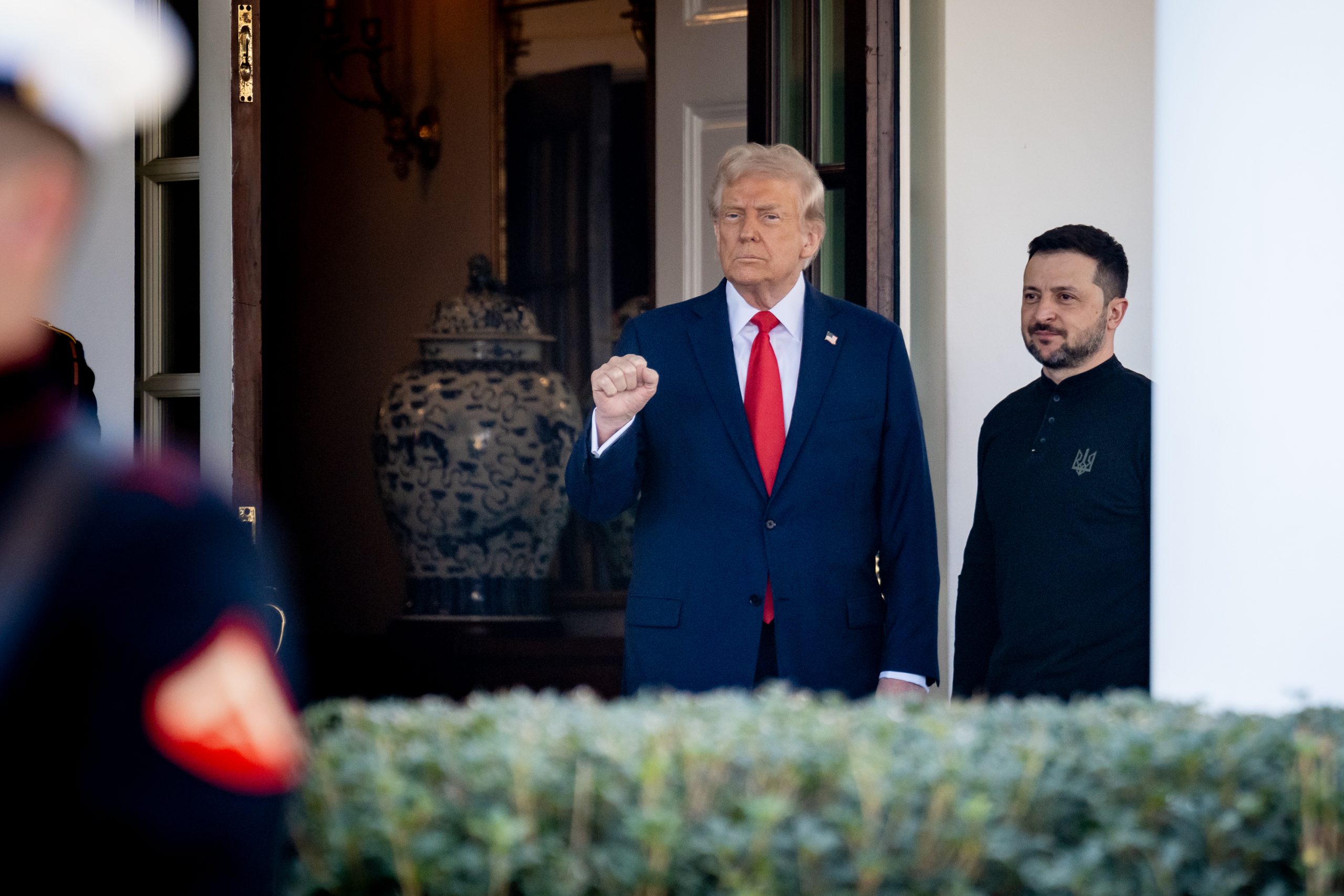
    President Donald Trump greets President Volodymyr Zelenskyy of Ukraine, Friday, February 28, 2025, in the White House West Wing Lobby
    Image: The White House, via Wikimedia Commons, Public domain.

    He repeated the theme in other public settings. At a CNN town hall in May 2023, he said Russians and Ukrainians were dying and that he would have the war ended in 24 hours. In August 2024, he told a National Guard Conference that, after winning and before even arriving at the Oval Office, he would have the war settled.

    Campaign rhetoric is often inflated. Candidates compress complicated policy into slogans because certainty sells better than caveats. But the 24-hour clock was different. It put a measurable number on a war involving occupied territory, security guarantees, U.S. aid, sanctions, Russian demands and Ukraine’s survival as a sovereign state.

    The clock changed after victory

    Once Trump was in position to act, the language shifted. AP reported that on Dec. 16, 2024, at Mar-a-Lago, Trump was asked whether he still believed he could make a deal with Vladimir Putin and Volodymyr Zelenskyy. His answer was no longer a guarantee: he said he was going to try.

    That was a meaningful move from certainty to effort. It did not mean diplomacy was dead, but it did show that the campaign line had run into the normal limits of statecraft.

    In January 2025, retired Lt. Gen. Keith Kellogg, Trump’s special envoy to Ukraine and Russia, floated a 100-day target for ending the war, according to AP. A 100-day horizon is still ambitious. It is also not 24 hours.

    Trump continued to project momentum. He said on Jan. 31 that his administration had held very serious discussions with Russia. After speaking with Putin and then Zelenskyy on Feb. 12, he said he thought the parties were on the way to peace. But movement toward talks is not the same as a signed settlement.

    Rubio reset expectations publicly

    The administration’s clearest public reset came from Secretary of State Marco Rubio. On April 18, Rubio told reporters that no one was saying the war could be ended in 12 hours, while warning that the United States might step back from negotiations if there was not enough progress, according to AP.

    Rubio’s comment was striking because it reframed the issue away from Trump’s one-day promise and toward the slower reality of diplomacy. It also suggested there was a limit to how long Washington would keep investing in a process that was not producing visible results.

    Trump’s own sarcasm explanation followed a similar logic. Supporters can read it as a familiar Trump move: deliberate exaggeration meant to signal urgency, confidence and pressure. In that view, the literal clock was never the point; the point was to show he would treat the war as an immediate priority.

    Critics see something else. They argue the sarcasm defense arrived only after the promise became impossible to square with events. The fact that Trump repeated the 24-hour claim across multiple venues makes it harder to dismiss as a single offhand line.

    Why Ukraine and Russia resisted

    The war began with Russia’s full-scale invasion of Ukraine in February 2022. By the time Trump made the 24-hour claim in 2023, the conflict had already become a grinding war over territory, sovereignty, military aid and security guarantees.

    Russia and Ukraine do not share the same definition of peace. Moscow has sought to lock in territorial and strategic gains. Kyiv has resisted concessions that could reward aggression or leave Ukraine vulnerable to another attack. Those positions cannot be reconciled by presidential confidence alone.

    The friction also became visible in Trump’s dealings with Zelenskyy. AP reported that a Feb. 28 Oval Office meeting turned contentious, with Trump accusing the Ukrainian leader of being disrespectful and later suggesting Zelenskyy’s anger toward Putin was an obstacle to a deal.

    Trump also applied public pressure. On April 23, he criticized Zelenskyy over Crimea and accused him of prolonging the killing field. The next day, after deadly Russian strikes on Kyiv, he addressed Putin directly on Truth Social, writing: “Vladimir, STOP!” and urging that the peace deal get done.

    The credibility question now

    The issue is not simply whether Trump used sarcasm. The bigger question is what voters, allies and adversaries should make of a foreign-policy promise that sounded specific during a campaign and became elastic once governing began.

    Presidents often overpromise on wars. Ending conflicts depends on enemy calculations, battlefield conditions, allied unity, domestic politics and the willingness of combatants to accept painful trade-offs. A U.S. president can influence those factors, but cannot dictate them all.

    That is why the 24-hour promise carried unusual stakes. It suggested that the main obstacle was not the conflict’s complexity, but the absence of the right negotiator. The months that followed have challenged that premise.

    There is still a fair distinction between bravado and policy. Trump’s allies can argue that he raised expectations to create leverage and force urgency. His opponents can argue that reducing a live war to a one-day dealmaking challenge understated the human and strategic costs.

    What remains unresolved

    The war remains the central fact. Trump’s revised explanation does not answer whether the United States is closer to a durable settlement, what terms Washington would accept, or how far it would pressure either side to compromise.

    It also leaves unclear how the administration would define success. A ceasefire, a frozen conflict and a lasting peace agreement are not the same thing. Each would carry different risks for Ukraine, Europe, Russia and the United States.

    For now, the 24-hour Ukraine war promise has become a test case in campaign accountability. Trump framed the war as a problem he could solve quickly. The record so far shows a much harder reality: negotiations can be opened with phone calls, but wars do not end on a slogan’s timetable.

  • GOP Donors Reportedly Seek Trump Refunds as Vance Exposes Money Rift

    GOP Donors Reportedly Seek Trump Refunds as Vance Exposes Money Rift

    The reported backlash is not just about one running mate. It points to a larger fight over whether Trump’s donor class will keep financing a party remade in his image.

    Major GOP donors are seeking refunds from Donald Trump’s political operation, according to a report, as J.D. Vance is drawing backlash from Republican contributors who reportedly “can’t stomach” Trump’s running mate. The dispute reflects a broader GOP funding split: Trump’s MAGA coalition elevated Vance, but some high-dollar donors who backed Trump’s candidate now appear unwilling to finance the ticket they helped underwrite.

    The money involved has been described as tens of thousands of dollars, not race-defining cash on its own. But refund requests are louder than donor grumbling, and they could signal a deeper loyalty test inside the Republican coalition.

    Refunds send a sharper message

    A disappointed donor can simply stop giving. A donor asking for money back is making a more pointed statement: the political product changed, and they no longer want to pay for it.

    Close up of Scrabble tiles spelling 'Donald Trump' on a wooden table.
    Image: Markus Winkler, via Pexels, Pexels License.

    That is why the reported refund requests matter beyond the dollar figure. High-dollar donors do more than write checks. They host private events, bundle contributions from friends and business circles, introduce candidates to other funders and signal whether a campaign is safe for establishment money.

    In a presidential operation, tens of thousands of dollars may be small compared with the cost of advertising, turnout programs and legal infrastructure. But donor revolt travels through elite networks quickly. One refund request can become a permission slip for others to pause, complain privately or skip the next fundraiser.

    For Trump, the immediate financial hit may be manageable. The bigger concern is whether the episode becomes a shorthand for a broader anxiety: that the Trump-Vance ticket is asking traditional Republican financiers to fund a version of the party they no longer recognize.

    Why Vance unsettles donors

    Vance is not a neutral vice-presidential-style figure dropped into the ticket to calm every faction. He is one of the clearest symbols of the Republican Party’s post-2016 transformation: more populist, more skeptical of foreign intervention and more willing to challenge old GOP donor assumptions on trade, business and America’s role abroad.

    That profile is exactly why many Trump loyalists like him. Vance speaks the language of the movement, defends Trump aggressively and presents himself as a convert from elite skepticism to MAGA conviction. To supporters, his shift from critic to ally makes him a compelling messenger for voters who once doubted Trump but now back him.

    To skeptics, the same biography raises different questions. The Washington Post has documented Vance’s earlier anti-Trump comments, including a 2016 NPR remark that he could not stomach Trump, as well as past private and public criticism from before his political rise. Vance later became one of Trump’s most prominent defenders and won his Ohio Senate seat with Trump’s backing.

    That arc gives both sides material. Allies see evolution. Critics see opportunism. Donors worried about stability, electability or policy direction may see risk.

    Trump’s leverage has limits

    Trump’s grip on Republican voters remains the central fact of GOP politics. His endorsement can clear primary fields, turn little-known figures into contenders and redefine what counts as acceptable inside the party. Vance’s rise is part of that story.

    Donor politics work differently. Wealthy contributors rarely control a party on their own, and Trump has spent years proving he can survive elite Republican resistance. But campaigns still depend on expensive machinery: data, field staff, lawyers, ads, travel, digital outreach and voter contact in competitive states.

    Small-dollar fundraising and mass enthusiasm can offset donor discomfort, especially for a candidate with Trump’s national brand. Yet high-dollar networks still matter because they create leverage at moments when campaigns need speed and scale.

    The tension is obvious. Trump can treat donor anger as proof that he is not controlled by the establishment. But if enough donors quietly stop hosting, bundling and vouching for the ticket, the campaign could feel the effects even without a dramatic public break.

    The money-versus-MAGA problem

    The reported Vance backlash exposes a conflict that has been building for years. Trump reshaped the Republican Party around cultural grievance, working-class appeal, immigration hard lines and suspicion of old power centers. Many major donors, meanwhile, still prefer predictable tax policy, business-friendly regulation, hawkish foreign policy and candidates who do not spook corporate circles.

    Those priorities can overlap, but they are not identical. Vance’s brand leans into the populist side of the coalition. He has built a reputation as a critic of parts of corporate power and as a skeptic of the foreign-policy consensus that many traditional Republican donors supported for decades.

    That makes him useful to Trump’s movement and uncomfortable for some donors. The very traits that reassure MAGA voters may unsettle financiers who want the party to look more conventional to suburban voters, business leaders and international allies.

    This is the central bargain Trump keeps testing: can he keep the donor class close enough for cash while presenting himself as a candidate who answers to voters, not wealthy Republicans? The reported refund requests suggest some donors think the balance has tilted too far.

    What remains unconfirmed

    The available reporting leaves important gaps. It does not establish how many donors are seeking refunds, whether Trump’s campaign or affiliated committees will return any money, or whether the anger is limited to a few contributors rather than a wider fundraising problem.

    It is also unclear what, exactly, is driving the objections. Some donors may dislike Vance’s policy views. Others may object to his past comments about Trump, his political style or the strategic wisdom of making him the face of the party’s next generation.

    Those distinctions matter. A personal grudge can fade. A policy split over trade, Ukraine, Wall Street, technology or corporate regulation can resurface at every fundraiser and in every private donor briefing.

    Campaigns often survive noisy flare-ups. They have a harder time when donor networks quietly decide not to call their friends, not to attach their names to events and not to reassure nervous contributors behind closed doors.

    The next cash test

    The most meaningful signs will not come from slogans. They will come from fundraising calendars, donor lists and campaign finance reports.

    If major events proceed as planned, bundlers stay publicly attached and high-dollar receipts remain strong, the campaign can argue the backlash was contained. If events are postponed, names disappear or donor-heavy filings soften, the refund requests will look less like an isolated protest and more like an early warning.

    Trump and Vance also face a messaging choice. They can dismiss unhappy donors as establishment holdouts, try to reassure them privately or turn the fight into a populist badge of honor. Each path carries a cost.

    Attacking donors may thrill the base but chill future checks. Reassuring donors may calm the money class but blunt the anti-establishment appeal that helped make Vance valuable to Trump. For now, the reported refund fight shows that Trump can dominate the Republican Party and still face resistance from the people expected to fund it.

  • At Least 13 Epstein Files Went Offline Before a Trump Image Returned

    At Least 13 Epstein Files Went Offline Before a Trump Image Returned

    BBC and Reuters reported that DOJ temporarily removed the image after victim-privacy concerns. Critics argue the missing-file episode still needs clearer tracking.

    At least 13 files from the Jeffrey Epstein release were no longer available on the Justice Department website by Saturday without explanation, the BBC reported. Among the material removed was an image that included Donald Trump and later reappeared after a Justice Department review, according to the BBC and Reuters.

    The department has said the image was flagged for potential action to protect victims and was taken down temporarily. After review, DOJ said there was no evidence that any Epstein victims were depicted in that photograph and restored it without alteration or redaction, the BBC reported.

    The missing-file problem came first

    The Trump image became the most visible example, but the broader issue was the disappearance of files from a public database. The BBC reported that at least 13 files from thousands released in connection with Epstein were unavailable by Saturday without an initial public explanation.

    That gap drew scrutiny because the release involves records Congress ordered and the Justice Department controls. Critics argue that a public archive on a politically sensitive and victim-sensitive case needs a clear way to show when files are removed, restored or changed.

    Democrats on the House Oversight Committee questioned the removals in a social media post directed at Attorney General Pam Bondi, asking, “What else is being covered up?” The allegation was political, but the underlying process issue was narrower: the public could see files had gone missing before it could see a detailed reason why.

    DOJ’s stated reason was victim protection

    According to the BBC, the Justice Department said on X that the image involving Trump had been flagged by the Southern District of New York “for potential further action to protect victims.” DOJ said it removed the image temporarily “out of an abundance of caution.”

    After the review, the department said it found “no evidence that any Epstein victims are depicted in the photograph” and reposted the image “without any alteration or redaction,” the BBC reported.

    Deputy Attorney General Todd Blanche rejected criticism that the removal was related to Trump. He told NBC News, according to the BBC, that the suggestion was “laughable” and that the decision had “nothing to do with President Trump.”

    What the image showed

    The disputed file was not described as a standard posed photo of Trump and Epstein. The BBC described it as an image of framed photos inside one of Epstein’s homes. In an open drawer, the image included a photo of Donald Trump with Jeffrey Epstein, Melania Trump and Ghislaine Maxwell.

    Reuters reported that the Justice Department restored a Trump photo to the public Epstein database. The BBC reported that the image was among items removed after thousands of Epstein-related files were released.

    The BBC also noted that Trump has consistently denied wrongdoing in relation to Epstein. The restored image, as described by the reports, was significant because of its handling in the release, not because DOJ said it showed victims.

    Redactions are necessary, but uneven handling fuels suspicion

    The Epstein records sit between two real obligations: public accountability and victim protection. The Justice Department has said it redacted categories of information that include personally identifiable information about victims, material depicting child sexual abuse, material depicting physical abuse, records that could jeopardize an active federal investigation and classified material tied to national defense or foreign policy, according to the BBC.

    Those categories leave room for judgment. A face, a name, a room detail or an image on a wall may look minor to a reader but still create privacy risks or investigative concerns.

    The BBC reported that other removed files appeared to show the same room in Epstein’s home, including a small massage room with wall images where some faces were redacted inconsistently. Even when redactions are justified, inconsistent presentation can make a database harder for the public to trust.

    What clearer tracking would answer

    The restored Trump image answered one narrow question: DOJ says its review found no evidence that Epstein victims appeared in that photograph, and the image was reposted without alteration or redaction.

    It did not answer every process question raised by the temporary removals. Critics argue the release still needs a clearer public accounting of which files were removed, whether each removal was temporary, what general standard was applied and whether any redactions changed.

    Such tracking would not require publishing victim-identifying details. It would mean giving the public a basic change record for a database built around one of the most scrutinized criminal cases in recent history.

    The dispute over the Trump image is therefore less about one restored file than about how the Justice Department explains movement inside the Epstein archive. When records disappear before an explanation appears, even a later restoration can leave the handling of the release under scrutiny.

  • Texas Is Rewriting History Class. Students Get the Bill

    Texas Is Rewriting History Class. Students Get the Bill

    The fight is not just over a few textbook lines. State standards can decide which facts become required knowledge and which disappear from the classroom map.

    The charge is blunt: Texas is trying to erase history from textbooks, and the fight over Texas history textbooks and curriculum standards has centered on the State Board of Education in Austin. Critics say students will pay the price if lessons on segregation, slave revolts, Jim Crow and the Tulsa Race Massacre are softened or stripped from what public schoolchildren are expected to learn.

    In a June 26 Houston Chronicle column, Joy Sewing reported that the board voted to cut previously proposed social studies lessons. The standards at issue shape what Texas students must learn from kindergarten through 12th grade and, if approved, would begin appearing in public schools in 2030.

    The vote is not abstract

    Curriculum standards can sound bureaucratic, but they are the skeleton underneath the school day. They influence textbook chapters, teacher guides, classroom pacing, homework questions and what districts decide is safe or necessary to teach.

    In Texas, the State Board of Education sets the Texas Essential Knowledge and Skills, the state expectations for what students should know and be able to do. A standard does not write every sentence of a textbook, but it tells publishers and schools which topics deserve space.

    That is why this fight matters beyond a single board meeting. A deleted lesson is not always announced with a ban. Sometimes it simply stops being required, and then it becomes easier for busy classrooms to skip.

    What Texas may cut

    The Chronicle reported that the State Board of Education voted to cut proposed lessons explaining racial segregation and slave revolts. It also reported that the board wanted to remove references saying African Americans were enslaved in the United States because of their skin color.

    The same report said the board planned to cut an explanation of Jim Crow laws, the system of state and local rules and practices that enforced racial separation and denied Black Americans equal treatment for decades after Reconstruction.

    Another flashpoint is language around Tulsa. The Chronicle said the board wanted to rename the 1921 Tulsa Race Massacre as the Tulsa Race Riots. That wording change may look small on paper, but it shifts how students understand who acted, who suffered and how organized the violence was.

    In 2025, the Justice Department issued a 126-page report on the Tulsa Race Massacre, describing an attack in which white Tulsans killed Black residents and burned homes and businesses in the Greenwood district. Federal investigators said the violence was so systematic and coordinated that it went beyond ordinary mob violence.

    The wording carries the politics

    History fights often hide in verbs, labels and missing causes. A textbook can mention slavery without explaining racial ideology. It can mention segregation without explaining power. It can mention Tulsa without making clear that a prosperous Black community was attacked and destroyed.

    That is not a neutral simplification. It changes the lesson.

    There is a fair debate over how much detail belongs in each grade. A first grader does not need the same material as a high school senior, and teachers need age-appropriate ways to discuss violence, racism and law. But age-appropriate is not the same as cause-free.

    Students do not need partisan speeches in their textbooks. They need enough evidence to understand how events happened, who made decisions, who was harmed and how those choices shaped the country they live in now.

    Texas textbooks travel far

    Texas is one of the biggest public school markets in the country, which gives its standards weight. Publishers have more flexibility than they once did, especially with digital materials, but a large adoption state still sends a powerful signal about what content is worth building.

    Even when a textbook is customized by state or district, the structure matters. Chapter headings, primary-source selections, teacher prompts and review questions can all be shaped by what a state requires.

    That means the Texas fight is not only a Texas story. When a major state trims uncomfortable history from required standards, it can influence the broader market of instructional materials and the political expectations around them.

    The strongest effect, though, is local. Texas students are the ones most likely to sit in classrooms where these choices become ordinary.

    Students inherit the gaps

    The price students pay is not only a lower test score or a missing fact on a worksheet. The bigger cost is a thinner civic education.

    If students learn that Native peoples simply vanished, they miss the policies and violence that drove removal. Sewing’s Chronicle column recalled an elementary social studies textbook that used that kind of wording, leaving out the Indian Removal Act of 1830 and the forced displacement of Native communities. She also cited the National Indian Child Welfare Association’s figure that, before the 1970s, 25% to 35% of Native children were removed from their communities and placed with white families.

    Those omissions matter because children often trust textbooks as the official version of reality. When a book leaves out force, law and resistance, students may conclude that injustice happened naturally, vaguely or accidentally.

    The harm is not limited to students whose communities were targeted by those histories. Black, Native, Latino and other students lose recognition of their families’ place in the national story. White students lose the chance to understand the systems that shaped the country they inherited.

    What remains before 2030

    At the time of the Chronicle report, the board was expected to take a final vote on the standards, with implementation in Texas public schools beginning in 2030 if approved. The long timeline does not make the issue less urgent. It means the decision could shape a full generation of lesson plans before many families notice the shift.

    There are still practical questions: how final language will read, how publishers will respond, how districts will choose materials and how much room teachers will have to add context. Standards do not control every classroom sentence, but they set the floor. A weak floor leaves more to chance.

    The cleanest test is simple: can the standards state hard history plainly? Slavery was racialized. Jim Crow was a legal and social system of oppression. Tulsa was a massacre, not a misunderstanding. Native peoples did not vanish.

    Teaching those facts is not about making students feel guilty. It is about giving them a usable map of the past. If Texas narrows that map, students will be left to find the missing roads on their own.

  • Idaho’s School Money Formula Could Be Rewritten

    Idaho’s School Money Formula Could Be Rewritten

    The formula is not just accounting paperwork. It helps decide how state dollars flow to districts and charters, and a rewrite could create real winners, losers and tradeoffs.

    Idaho’s school funding formula may be overhauled, and the fight is really about public school funding in Idaho: how the state sends money to Idaho public schools, what the Idaho Department of Education calculates, and which districts or charters could gain or lose if the rules change. An overhaul could reshape the funding system that helps pay teachers, operations and targeted programs across the state.

    The timing matters because Idaho’s formula is not a single pot of money. It is a layered system built in state law, budget language and technical calculations that most families never see but every school feels.

    The formula behind every classroom

    The Idaho Department of Education says state general and dedicated funds are distributed to public schools under Title 33, Chapter 10 of Idaho Code and appropriation intent language. In plain English, lawmakers set the rules and the budget, and the state education agency turns those rules into payments.

    The department’s Public School Finance Division says it calculates payments and provides technical support to Idaho school districts and charter schools. It also prepares reports on revenues, expenditures, budgets, staffing, school property taxes, attendance and enrollment using data from districts, charters and other government entities.

    That matters because a funding formula is not just a spreadsheet. It decides how state dollars recognize student counts, staffing needs, local conditions, special programs and district flexibility.

    When a state changes that formula, even a small technical adjustment can shift real money between schools.

    How Idaho schools get paid

    Idaho’s system relies heavily on state funding. In a January 2025 public article posted by the Idaho Department of Education, Superintendent of Public Instruction Debbie Critchfield wrote that about 60% of school funding in Idaho comes from the state, with the rest coming from local and federal sources.

    A U.S. Department of Education-linked ERIC report on state education funding formulas describes Idaho’s formula as having three primary allocation mechanisms: salary and benefits apportionment, categorical funds and discretionary funds.

    Those categories point to three basic questions. How does Idaho support school employee compensation? Which dollars are restricted for specific purposes? How much money can local school leaders use flexibly?

    That mix is where an overhaul could become politically sensitive. Districts want predictability. Charter schools want funding that follows their students fairly. Rural communities often worry that formulas built around averages can miss the higher costs of serving small, spread-out populations.

    What an overhaul could change

    No final statewide rewrite can be judged until actual bill language, fiscal notes and district-by-district estimates are public. But the pressure points are clear from how school finance formulas work.

    A serious overhaul could change the student counts used to distribute dollars, the way staffing or salary support is calculated, the weight given to certain student needs, or the balance between restricted categorical money and flexible discretionary funding.

    It could also revisit how growth is treated. Fast-growing districts and charter schools tend to care deeply about whether money follows current enrollment quickly. Smaller or declining districts often care just as much about whether the formula gives them time to adjust before losing support.

    The hardest part is not designing a formula that sounds fair in theory. It is designing one that does not destabilize schools in practice.

    Why the politics are tricky

    School funding rewrites usually create a simple problem: if the total pot of money does not grow enough, one district’s gain can become another district’s loss. That is why formula debates often turn into fights over transition funding, hold-harmless provisions and whether the state is adding new dollars or merely redistributing existing ones.

    Idaho has already seen school-funding changes become politically difficult. A 2022 governor’s office document tied to public school funding and enrollment shows that proposed changes in this area have previously reached the governor’s desk and run into resistance.

    Supporters of an overhaul can argue that Idaho needs a funding system that is more transparent, more responsive to student needs and better aligned with how schools operate now. They may also argue that older formulas can become patched together over time until few people outside finance offices can explain them clearly.

    Skeptics may ask a different question: who pays for the transition? If the answer is districts with fewer students, rural schools with fixed costs, or communities already relying on local levies, the politics can harden quickly.

    The stakes for families

    For parents and students, the formula debate can sound remote until it shows up in class sizes, bus routes, course offerings, school calendars, staff retention or local tax requests.

    If an overhaul increases flexible dollars, local leaders might have more room to solve specific problems. If it directs more money through categorical programs, the state may gain more control over how funds are used. Neither approach is automatically better; each reflects a different view of who should make spending decisions.

    The details could also affect how districts plan. Superintendents and school boards build budgets months before a school year begins. A formula rewrite without clear phase-in rules can make hiring, contracts and program planning harder.

    That is why the most important documents may not be the first announcement. They will be the fiscal models showing how much each district and charter would receive under the old system compared with the new one.

    What remains unclear

    The central unanswered question is whether Idaho is looking at a true overhaul or a narrower adjustment. A true overhaul would likely revisit the architecture of the formula. A narrower change might tweak one or two components while leaving the broader system intact.

    It is also unclear how aggressively state leaders would try to simplify the formula. Simpler systems are easier for the public to understand, but they can miss local realities. More tailored systems can be fairer on paper, but they often become harder to administer and harder for taxpayers to follow.

    The clean takeaway is this: Idaho’s school-funding formula is the engine under the hood of public education finance. If it is rewritten, the debate will not just be about education policy. It will be about state priorities, local control and whether Idaho can change the rules without leaving some schools behind.