
At Dollywood, Dolly Parton’s story is not limited to a greatest-hits playlist or a souvenir wall. Songteller brings visitors through the personal memories, songwriting milestones and signature style behind one of country music’s most recognizable careers.
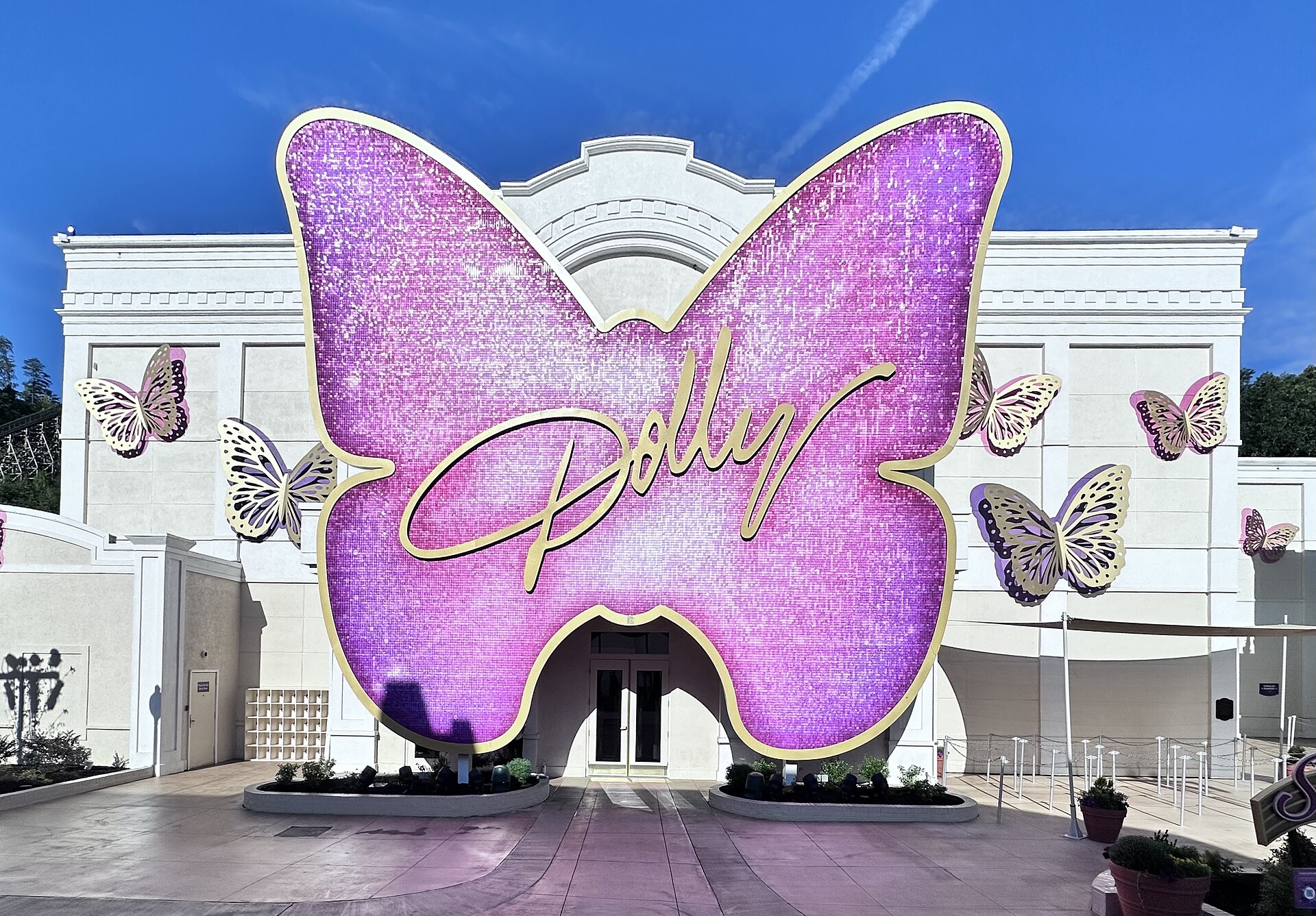
Dolly Parton tells her own story to fans through Songteller, a walk-through exhibition space at Dollywood. The attraction shares stories from Parton’s life and career with visitors through her recorded narration, personal objects, performance footage and immersive displays.
For fans looking for the place where Parton’s biography becomes a physical experience, Songteller is the centerpiece of the Dolly Parton Experience, which opened at the Tennessee theme park in 2024. It is designed less as a quick celebrity photo stop than as a guided journey from her East Tennessee childhood to her rise in Nashville and beyond.
Her voice sets the tone
The most revealing part of Songteller is that visitors do not simply read about Parton’s early ambitions. They hear her speak for herself.
According to USA TODAY’s reporting on the attraction, audio inside the exhibition includes Parton reading from a letter she wrote to her parents after moving to Nashville. In it, she reassures them that she arrived safely and says she believes she will make it if she works long and hard enough.
That recording gives the exhibition a different texture from a conventional celebrity museum. The story is not only presented as a polished retrospective of awards, costumes and hit songs; it begins with a young songwriter trying to make a life in Music City.
Parton told USA TODAY when the experience opened that she hoped visitors would feel that “it’s just about the journey.” That framing is important. Her career has become so large that the scale of the finished legend can sometimes eclipse the uncertain, ordinary moments that came first.
A career told through objects
Songteller occupies the former home of Dollywood’s Chasing Rainbows Museum, which closed after the 2021 season. The newer Dolly Parton Experience is spread across multiple buildings and is roughly triple the size of that earlier museum, according to USA TODAY.
Inside Songteller, the route follows Parton from childhood through her early Nashville years and eventual global fame. The exhibits include a replica of the famous coat of many colors made by her mother, along with a photograph of the dry-cleaning receipt on which Parton wrote the song inspired by it.
Visitors also encounter details that place well-known milestones in everyday settings. The exhibition recounts how Parton met her husband, Carl Dean, at a laundromat, while her guitars help document the working musician behind the glamorous stage persona.
One instrument on display is an acoustic Gibson covered in paisley-pattern rhinestones that Parton used on a 2005 tour. That mix of handmade family memory, songwriting material and touring gear makes the collection feel intentionally uneven in the best sense: domestic, professional and theatrical all at once.
More than a greatest-hits museum
Parton’s music and film work are threaded throughout the exhibition, but Songteller also uses a 360-degree projection-mapped show to connect the objects to the places that shaped her. The presentation moves through landmarks including her childhood home in Locust Ridge and Nashville’s Ryman Auditorium.
That approach reflects a broader challenge for any museum focused on a living cultural legacy: how to show more than trophies. A wall of plaques can establish achievement, but it cannot easily explain why a particular place, family story or handwritten lyric became part of a performer’s mythology.
Songteller’s answer is immersion. Fans can see the artifacts, but they are also asked to move through a narrative built around memory, place and voice. The risk with any branded attraction is that it can become a carefully managed version of a celebrity’s life. The counterargument is that Parton’s direct participation gives the presentation an authorship many retrospective exhibits lack.
It still remains a curated experience, not an exhaustive account of every chapter in a decades-long career. But that is part of its purpose: it offers visitors a coherent path through the stories Parton chose to foreground.
Style gets its own showcase
Across from Songteller is Behind the Seams, an exhibition devoted to Parton’s fashion, shoes, wigs and performance image. The space occupies the former Dolly’s Closet boutique and leans into the visual side of a career that has always treated glamour as both entertainment and self-expression.
Among the items reported on display is a bell-bottom jumpsuit designed by Lucy Adams and worn on Parton’s 1970s television variety show, Dolly. Some of the clothing had not previously been exhibited.
Rebecca Seaver, Parton’s niece and Dollywood’s director of museum and archive services, said at the opening that the goal was to represent the different facets of her aunt, including her songwriting and her look. The distinction matters because Parton’s image was never separate from her work; it was one of the ways she made herself instantly legible in an industry that often underestimated women artists.
The exhibit also gives guests a lighter interactive stop, allowing them to dress a cartoon version of Parton with magnetic outfit pieces. It is a playful feature, though the larger point is serious: her clothes are part of the archive, not an afterthought.
Family stories extend the visit
The Dolly Parton Experience extends beyond Songteller and fashion displays. At the entrance to Dreamsong Theater, the Precious Memories exhibit presents childhood photographs and family footage alongside recorded stories from Parton about her relatives and faith.
Cyndi McCormack, Dollywood’s vice president of guest experience and creative director for the attraction, told USA TODAY that Parton recorded those accounts in a studio because the team believed she could tell her own stories better than anyone else.
Visitors can also see Dolly’s Home-on-Wheels, a former motor coach used by Parton from 1994 to 2009, relocated within the experience. An on-site Dolly’s Fan Shop sells exclusive merchandise, making clear that the attraction blends museum presentation with the commercial reality of a major theme park.
That mix will not appeal equally to every visitor. Some may want a deeper archival account with more historical context; others will appreciate an accessible, family-friendly introduction. Songteller’s strength is that it does not make fans choose between the intimate and the spectacular.
What visitors need to know
The Dolly Parton Experience is open to all Dollywood guests. USA TODAY reported that it does not carry a separate admission charge, although visitors need valid park admission to enter Dollywood.
For travelers, that means Songteller works best as part of a park day rather than as a standalone museum ticket. It also helps explain why the experience has become a significant part of Dollywood’s identity: it anchors the rides, shows and food around the personal history of the artist whose name defines the park.
Dollywood announced a 10-year, $500 million investment campaign in 2021, and the larger Dolly Parton Experience was among the additions tied to the park’s continued expansion. The physical exhibits give that growth a human center.
The takeaway is simple. Songteller is where fans can move beyond the public image of Dolly Parton and encounter the stories she chose to preserve in her own voice: the letter home, the coat, the guitars, the family memories and the long road from East Tennessee to worldwide fame.
Leave a Reply