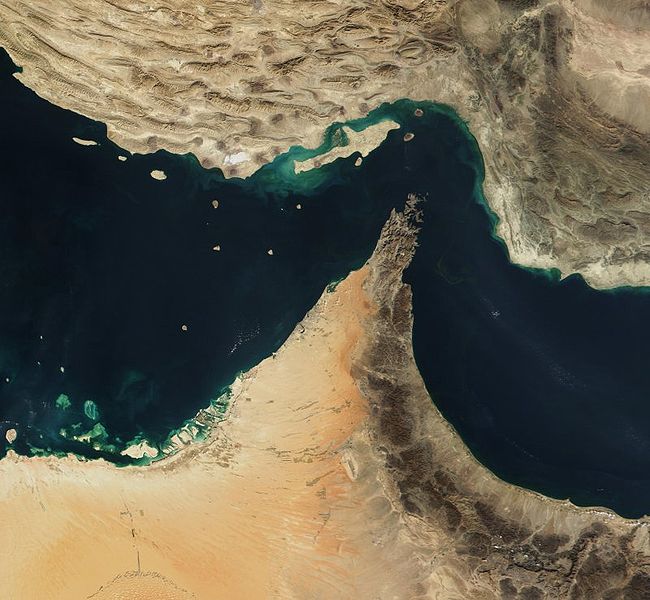
The reported corridor is designed to keep oil moving through one of the world’s most sensitive maritime chokepoints. Its apparent success does not remove the danger of Iranian attacks or the strain of sustaining a heavily protected route.
Iran faces a new challenge in the Strait of Hormuz: a U.S. Army task force based at Fort Bragg, North Carolina, is reportedly quietly operating and supervising a tanker corridor through or near the waterway. The reported operation moves tankers along Hormuz’s southern side near Oman, seeking to keep oil flowing despite Iran’s ability to threaten or restrict passage.
That matters because the Strait of Hormuz is a narrow global energy choke point. A route that can carry tankers past Iran may reduce Tehran’s leverage and blunt the economic impact of disruptions—but it also depends on intensive U.S. protection and could remain vulnerable to missiles, drones and miscalculation.
A southern route near Oman
National Security Journal, citing reporting by Axios, said the U.S. military quietly established a shipping corridor in and out of the strait. The report said an Army task force at Fort Bragg supervises the effort and tracks vessels using it.
Rather than using the northern passage closer to Iran, tankers reportedly travel through a southern channel near Oman. The distinction is central: geography does not make the route safe, but it may give ships more distance from Iranian forces positioned along Iran’s coast and islands.
The report said the corridor had been operating for several weeks, with roughly 15 to 20 tankers entering and exiting each night. It described a system that helps empty tankers enter the Gulf from the Arabian Sea, load oil from regional producers and depart again.
This is more than an escort mission. If the reporting is accurate, it is a managed logistical pipeline intended to restore a measure of predictable commerce in a waterway where ordinary commercial navigation has become a security operation.
Why Hormuz carries global weight
The Strait of Hormuz connects the Persian Gulf to the Gulf of Oman and the Arabian Sea. It is one of the world’s most important maritime routes for crude oil and other energy shipments, linking major Gulf exporters with customers across Asia, Europe and beyond.
Even partial disruption can reverberate far outside the region. Fewer ships moving through the strait can mean longer routes, higher insurance costs, delayed deliveries and upward pressure on energy prices. Those effects can reach consumers through fuel, transportation and goods costs.
That is why a reported flow of 10 million barrels a day is consequential. National Security Journal said Axios was told that volume is about half of the daily level seen before the conflict described in the report. Half-capacity passage is not a return to normal, but it is materially different from a near-total stoppage.
For the United States and its partners, the practical objective appears to be keeping a viable artery open without claiming that the larger maritime security crisis has been resolved.
Iran’s leverage is being tested
Iran has long treated the strait as a point of strategic leverage. Its geography, coastal military positions and ability to threaten ships with drones, missiles, mines or fast-moving vessels give Tehran ways to raise the cost of passage even if it cannot permanently seal the waterway.
A functioning southern corridor challenges that leverage. It suggests the United States can create protected movement for at least part of the tanker trade and deny Iran a complete veto over traffic through Hormuz.
Still, “control” is a far stronger claim than the available reporting supports. A U.S. official quoted by Axios said the United States had been controlling the southern lane for two months and that Iran’s Islamic Revolutionary Guard Corps could be a nuisance but did not control the strait.
Iran’s capacity to disrupt the route remains significant. The National Security Journal account, citing The New York Times, said Iran had fired on ships trying to traverse the strait and that a vessel near Oman was hit during the week of the report, killing a crew member. That is a reminder that traffic moving does not equal traffic moving safely.
Protection comes at a price
The corridor reportedly relies on U.S. fighter jets to guard against Iranian drones and missiles. The account also said U.S. officials claimed Iran’s radar capabilities had been degraded, potentially reducing Tehran’s ability to monitor the route.
Those measures could help explain why tankers have been able to transit. They also show why this is not an easily scalable substitute for normal shipping. Maintaining air cover, maritime awareness, ship coordination and rapid-response capacity consumes personnel, equipment and planning every day.
Joshua Tallis of the Center for Naval Analyses told the Times that the current approach was extremely labor-intensive compared with prewar conditions. That assessment captures the trade-off: the United States may be able to sustain a corridor, but the operation is far more demanding than simply allowing commercial traffic to travel freely.
There is also an escalation risk. Each military asset deployed to protect shipping can deter an attack, yet every close encounter creates another chance for an incident to expand into a broader confrontation.
Success is real but limited
Michelle Wiese Bockmann, a shipping analyst at maritime analysis firm Windward, told the Times that the southern corridor had been extraordinarily effective despite attacks. That is the most encouraging reading of the reported operation: it has restored some oil movement under difficult conditions.
The less optimistic view is that effectiveness may be temporary. A corridor known to commercial operators, military forces and now the public can become easier to monitor, target or pressure. Public disclosure also raises the question of whether the route’s operational details can remain protected.
There is a diplomatic complication as well. The National Security Journal account said reported Iran-Oman talks over the strait’s status appeared to have stalled. Oman’s location beside the southern channel makes its role especially important, and any shift in regional diplomacy could affect the corridor’s future.
The unanswered question is whether this becomes a durable safety valve or an expensive stopgap. The reported tanker route gives Washington and regional producers a way to keep some oil moving. It does not eliminate Iran’s ability to impose danger, delay and cost in the Strait of Hormuz.
What to watch next
- Tanker volume: Whether the reported 10 million barrels a day can be maintained or increased.
- Security incidents: Further strikes, drone activity or attempted interference near Oman would test the corridor quickly.
- U.S. military posture: Sustained air and maritime protection would signal that the route remains a high-priority mission.
- Iran-Oman diplomacy: Any revived negotiations could reshape the political conditions around the southern lane.
- Energy-market response: Shipping rates, insurance costs and oil prices may reveal whether traders see the corridor as dependable.
The reported Fort Bragg-led effort does not make Hormuz routine again. Its importance lies in proving that even under pressure, a protected route may prevent Iran from turning a strategic chokepoint into a complete shutdown.
Leave a Reply