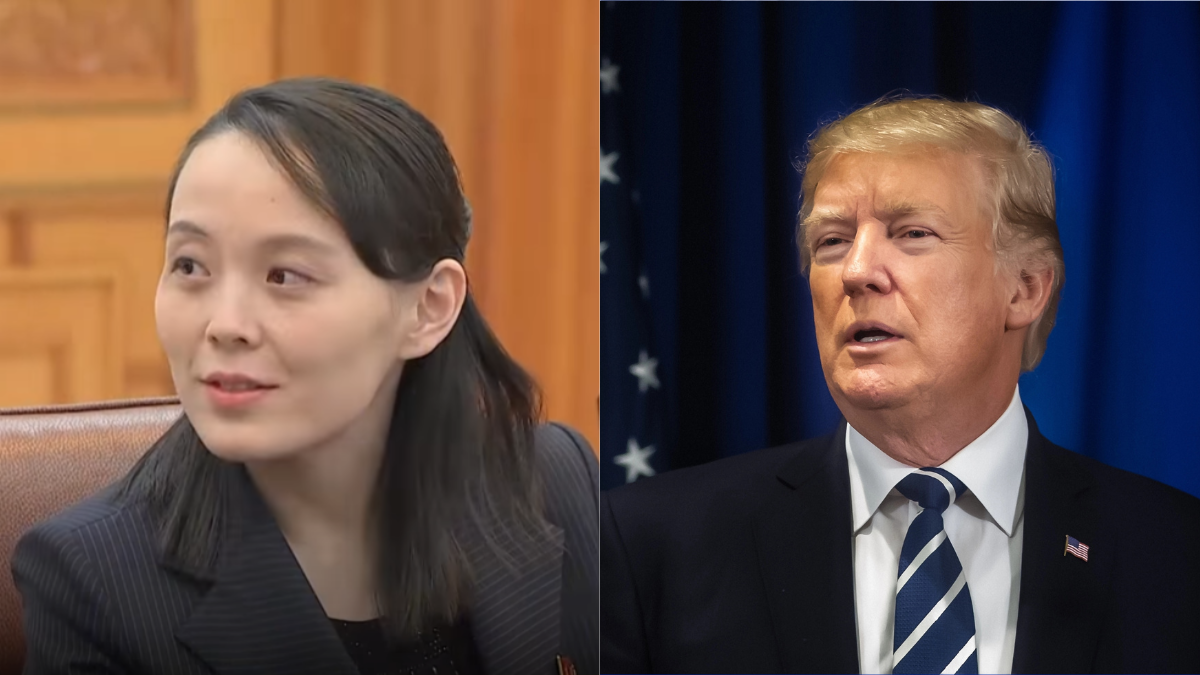
Trump presented the shortened U.S.-South Korea exercises as a goodwill gesture. Kim Yo Jong’s response suggests Pyongyang does not see the move as enough to change the wider military and political standoff.
Kim Jong Un’s sister, Kim Yo Jong, mocked Donald Trump’s goodwill gesture after Trump ended joint United States-South Korea military exercises early in Washington and Seoul. Her criticism was connected to the military war games that North Korea has long treated as a direct security threat, turning a planned concession into another sign of distance between the two sides.
The exchange matters because the drills are not a symbolic side issue. They sit at the center of the uneasy balance between defending South Korea and persuading North Korea that the United States is open to diplomacy.
Trump’s gesture met a blunt response
The Wall Street Journal reported that Trump moved to end the joint Washington-Seoul exercises early, describing the step as a goodwill gesture toward Kim Jong Un. The intended message was straightforward: reducing a military activity objected to by Pyongyang could help create room for engagement.
Kim Yo Jong did not treat it as a breakthrough. The sister and senior adviser to North Korea’s leader dismissed the overture as ineffective, according to reporting cited by the Journal. That reaction is the substance behind the sharper language in accounts describing her as mocking Trump’s move.
It is a familiar diplomatic problem. One government calls a step de-escalatory; the other says it does not address the issue that matters most. The gap can be especially wide when the action involves military preparedness, deterrence and public displays of resolve.
Why the drills carry such weight
Joint U.S.-South Korea exercises are often called war games by North Korea. Seoul and Washington frame them as training designed to maintain readiness under their security alliance.
North Korea sees the same activities through a different lens. Its government has repeatedly portrayed large-scale allied exercises as evidence of hostile intent, particularly when they involve forces and capabilities that could be used in a conflict on the Korean Peninsula.
That leaves Washington and Seoul with a difficult calculation. Scaling back drills can be presented as a diplomatic opening, but it can also raise questions about how the allies preserve coordination and deterrence. Continuing them, meanwhile, risks reinforcing Pyongyang’s argument that U.S. policy remains adversarial.
The dispute is therefore about more than a training schedule. It is about whether military restraint can build trust when the parties disagree over the source of the threat.
Kim Yo Jong’s role matters
Kim Yo Jong is not merely a family member speaking from the sidelines. She is widely regarded as one of North Korea’s most influential officials and has frequently delivered messages aimed at Seoul and Washington on behalf of the leadership.
Her public intervention gives the response political weight, even if it does not by itself announce a formal policy change. In North Korea’s tightly controlled system, high-profile statements from senior figures are closely read for what they indicate about the leadership’s position.
CNN reported separately that Kim Yo Jong said she knew “absolutely nothing” about a reported call involving Trump and Kim Jong Un. Taken alongside the rejection of the drill-related gesture, that account points to a larger uncertainty: there is no clear public evidence of a revived direct channel between the leaders.
That does not rule out private contacts or future negotiations. It does mean outside observers should be cautious about treating a reduced exercise schedule as proof that a diplomatic breakthrough is underway.
A concession is not a deal
Trump’s decision illustrates the limits of unilateral gestures in a relationship shaped by decades of distrust. A move intended to signal flexibility may have little effect if North Korea believes it is temporary, insufficient or disconnected from broader demands.
For Pyongyang, the central question may be whether the United States is changing its overall military posture and political approach, not whether one set of exercises ends early. For Washington and Seoul, the central question is whether any adjustment produces a measurable reduction in tension rather than simply inviting further demands.
- Washington’s view: a pause or reduction can show willingness to ease tension without abandoning the alliance with South Korea.
- Seoul’s view: military readiness and close coordination with the United States remain essential security interests.
- Pyongyang’s view: exercises can be portrayed as proof that the United States retains a threatening posture.
These positions are not easily reconciled through rhetoric alone. They require agreement on what each side would do next, what it would receive in return and how compliance or de-escalation would be assessed.
What remains unclear after the exchange
It is not yet clear whether the early end to the exercises will be followed by further U.S. concessions, a formal proposal for talks or another shift in the scale and format of future drills. Nor is it clear what North Korea would consider a meaningful enough step to alter its own posture.
The reporting also does not establish that Kim Jong Un personally responded to Trump’s gesture. Kim Yo Jong’s remarks are significant, but they do not provide a public roadmap for negotiations or specify conditions for a meeting.
The immediate takeaway is more modest: Trump tried to use the U.S.-South Korea exercises as a goodwill signal, and North Korea publicly rejected the premise that the signal was sufficient. The episode shows why the Korean Peninsula’s military tensions remain resistant to quick diplomatic fixes.
For now, the argument over war games is likely to persist because it compresses the larger conflict into one recurring question: how can the United States and South Korea maintain security while North Korea seeks proof that it is no longer being threatened?
Leave a Reply