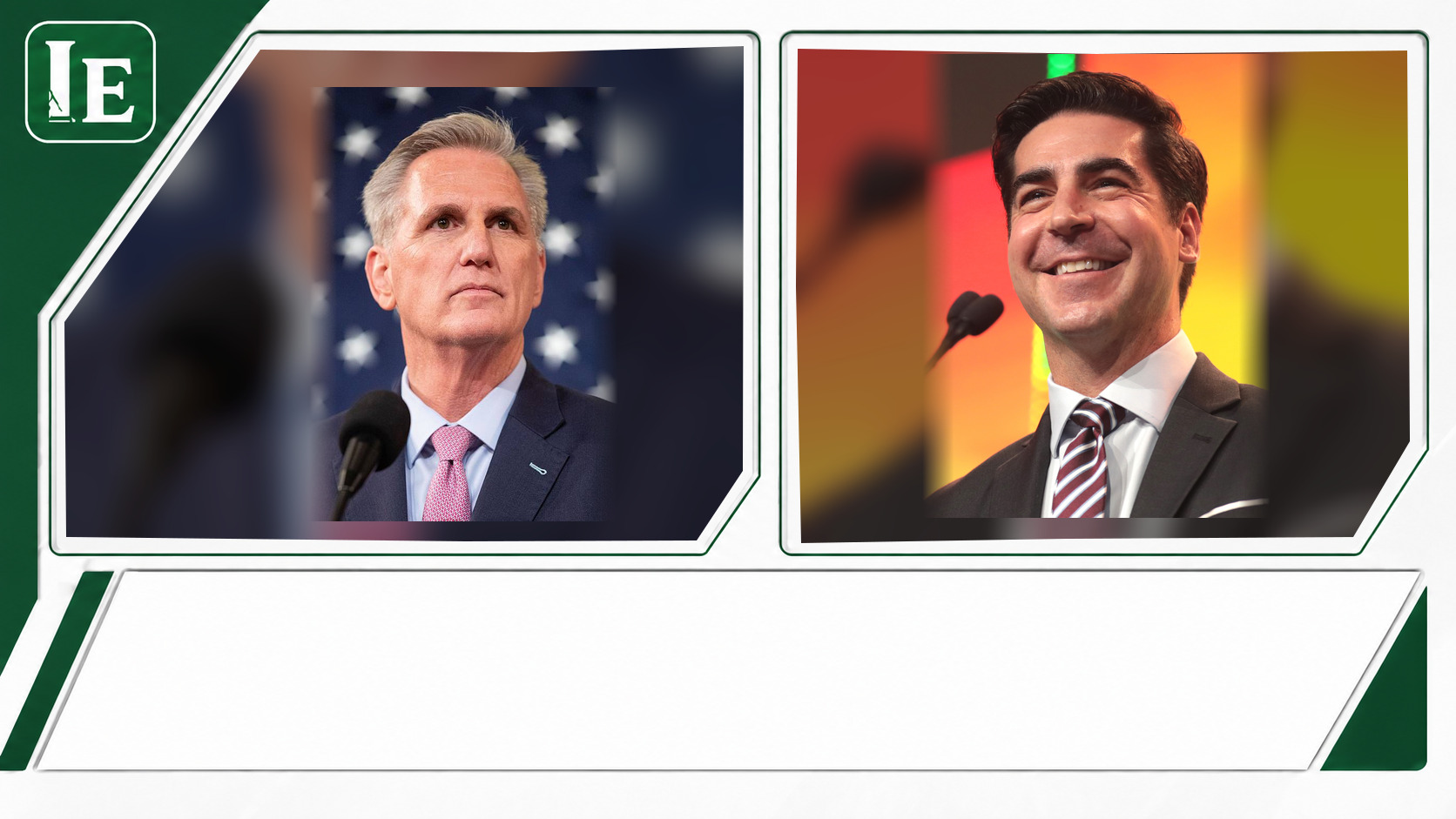
The on-air exchange turned on a narrow but consequential distinction: whether Donald Trump had endorsed defeated Florida Rep. Cory Mills. It also showed how quickly a campaign narrative can shift when an endorsement record is challenged in real time.
On August 19, 2026, Fox News host Jesse Watters was fact-checked live during a discussion of Tuesday night’s Florida election results. Former House Speaker Kevin McCarthy corrected Watters after he said Donald Trump had not endorsed Rep. Cory Mills, the Florida Republican who lost his primary to Ryan Elijah.
The exchange on Jesse Watters Primetime matters because McCarthy’s correction centered on an important distinction in Trump-era politics: a candidate can have the president’s formal endorsement without receiving a sustained public campaign push. In this case, that difference became the entire point of the on-air disagreement.
McCarthy challenged Watters’ claim
Watters was discussing the result in Florida’s 7th Congressional District, where Mills, the incumbent Republican congressman, was defeated by former television reporter Ryan Elijah.
According to the Daily Express US report, Watters said Trump “did not endorse Mills.” McCarthy immediately pushed back, saying Trump did endorse Mills, but “just didn’t go out and campaign hard.”
That is the key factual dispute. Watters’ statement treated Trump’s apparent lack of active campaigning as evidence that no endorsement existed. McCarthy described the situation differently: Trump had made an endorsement, but had not invested heavily in helping Mills win.
The moment was brief, but its impact was clear. Live television does not leave much room to revise a claim after a guest disputes it, especially when the topic is a high-profile political figure’s documented backing of a candidate.
The Florida race behind the exchange
The discussion followed the Republican contest involving Mills and Elijah in Florida’s 7th District. The Daily Express US reported unofficial results showing Elijah with 47.1% of the vote and Mills with 34.3%.
Elijah is expected to face Democrat Bale Dalton in the general election for the House seat, according to the report. The race has drawn attention not only because of Mills’ defeat, but because it offered an immediate test of how Trump’s support is interpreted after a candidate loses.
Florida’s 7th District is favorable terrain for Republicans at the presidential level. Trump carried the district by 12 percentage points in the 2024 election, the report said. But a presidential result and a party primary are not interchangeable, particularly when a candidate’s standing with voters becomes complicated.
That is why Watters’ wording drew McCarthy’s response. The question was not simply whether Mills lost. It was whether the loss could be framed as proof that Trump had withheld an endorsement from him.
An endorsement is not a campaign
Trump’s endorsements carry enormous symbolic value in Republican primaries, but they do not all look alike. Some are amplified at rallies, in campaign appearances, fundraising appeals, social-media posts and repeated statements from allies. Others are formal declarations that receive comparatively little follow-up.
McCarthy’s point was that Mills fell into the latter category. A formal endorsement can remain on the record even if the endorser later appears far more enthusiastic about another candidate or declines to make the race a personal priority.
The Daily Express US reported that Trump endorsed Mills in February, then posted support for Elijah after Mills’ defeat. Trump wrote that he had urged Mills to leave the contest and praised Elijah as a candidate who stood for “EVERYTHING MAGA.”
Those two facts can sit together, even if they create an awkward political story: Trump may have formally backed the incumbent earlier in the cycle, while signaling later that he saw Elijah as the preferable standard-bearer going forward.
Why the wording carried weight
For political television, the difference between “was not endorsed” and “was not actively campaigned for” may sound technical. In a primary, though, it changes who appears responsible for the outcome.
If Trump never endorsed Mills, the result could be presented as a straightforward rejection of a candidate who lacked the president’s support. If Trump endorsed him but did not campaign forcefully for him, the loss points to a more complicated reality: an endorsement alone may not overcome local concerns, weak momentum or an energized challenger.
Watters appeared to be making a broader argument about what Mills’ defeat meant for the Republican Party and its hold on the seat. McCarthy’s correction did not settle every question surrounding the contest, but it narrowed the claim that could fairly be made about Trump’s role.
There is also a practical media lesson in the exchange. Guests on live political programs can serve as an immediate check on a host’s framing, even when they broadly share the same party or ideological ecosystem.
Mills’ loss has wider implications
The Florida result comes as Republicans seek to protect their congressional position ahead of November’s midterm elections. The Daily Express US reported that Republicans hold narrow majorities in both the House and Senate, raising the stakes around races that could become competitive in the general election.
McCarthy suggested that Mills’ defeat could ultimately help Republicans retain the seat, arguing that a Mills victory might have put it in greater jeopardy. That is a political judgment, not a settled outcome; Elijah still has to win the general election.
Trump’s influence remains central to Republican primaries, but the Florida contest shows the limits of treating every endorsement as a guarantee. The report noted that 10 Trump-endorsed candidates had lost primaries that year.
Those losses do not erase the power of Trump’s backing. They do suggest that endorsement politics works on a spectrum, shaped by timing, intensity, candidate quality and local voter sentiment.
What remains unresolved after the segment
The on-air correction answered the narrowest question: McCarthy said Trump had endorsed Mills, contrary to Watters’ statement. The larger question is how much practical value that endorsement retained by the time Florida Republicans voted.
Trump’s later praise for Elijah makes the political sequence especially notable. It may be read as a pivot toward the winner, an effort to unify Republicans behind the nominee, or both. The available report does not establish whether Trump’s level of activity was decisive in Mills’ loss.
What the exchange did establish is that endorsement records are not as simple as television shorthand can make them seem. A politician can have a formal endorsement, receive limited visible help, lose anyway and then watch the party quickly rally around the person who beat them.
For Watters, McCarthy and Fox News viewers, the moment was a live reminder that the distinction matters—particularly when a race is being used to measure Donald Trump’s influence inside the Republican Party.
Leave a Reply