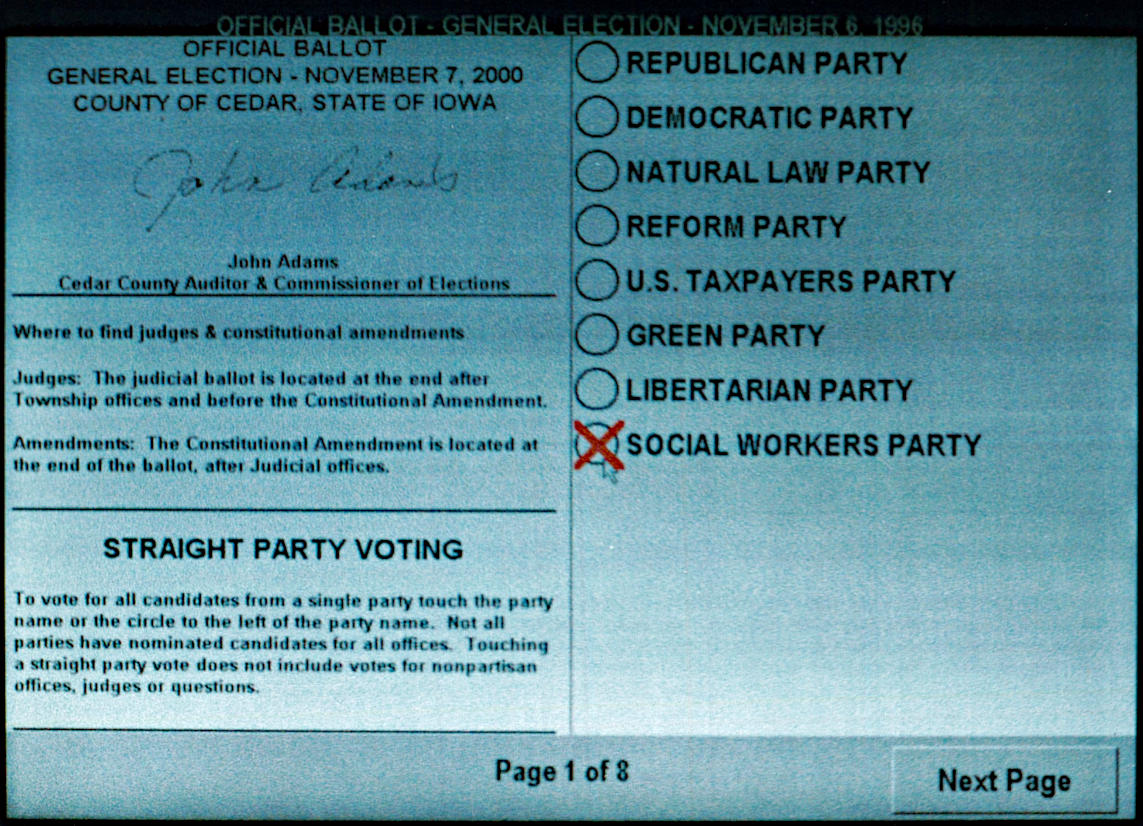
A reported finding of no voting-machine fraud did not settle the argument around election technology. Instead, it put the cybersecurity firm behind the test at the center of a familiar dispute over who gets trusted when political claims meet technical evidence.
A cyber firm found no fraud while testing a voting machine for the Trump administration, according to CNN, and the firm then faced a wave of backlash. The dispute matters because the test involved election technology, a subject where claims about security flaws are often treated as proof that votes were changed—even when investigators do not reach that conclusion.
The reported episode shows how difficult it can be for technical findings to land in a political environment shaped by years of election-fraud allegations. A finding of no fraud is not a claim that any machine is beyond scrutiny; it is a narrower conclusion about what the testing did and did not show.
No fraud finding, fierce response
CNN reported that the cybersecurity firm tested a voting machine for the Trump administration and did not find fraud. Rather than ending the debate, that result reportedly triggered backlash against the company.

That reaction reflects a central tension in election-security arguments. Some people want technical reviews to uncover proof for longstanding claims of widespread manipulation. When a review instead fails to substantiate fraud, the researchers, their methods or their motives can quickly become the focus.
The available source material does not establish that the firm’s work was intended to answer every question about every voting system. That distinction is important. Testing one machine or one configuration cannot, on its own, serve as a comprehensive verdict on election administration nationwide.
Security questions are not fraud proof
Voting equipment can be examined for software weaknesses, configuration problems, physical-access risks and procedural failures. Those are legitimate security concerns, and identifying one may justify a fix, stronger safeguards or additional testing.
But a vulnerability is not the same thing as evidence that fraud occurred. To establish election fraud, investigators would need evidence connecting a specific action or weakness to altered results, lost ballots or another concrete impact on an election outcome.
That gap is often lost in public debate. A system can require continual auditing and improvement while there remains no evidence that it changed votes in a particular contest. Conversely, a statement that no fraud was found should not be distorted into a claim that oversight is unnecessary.
What federal officials said in 2020
The federal government’s election-security agencies and state election officials made a similarly narrow but significant assessment after the 2020 presidential election. In a joint statement, the Cybersecurity and Infrastructure Security Agency, the Election Assistance Commission and election officials said there was no evidence that any voting system deleted, lost or changed votes, or had been compromised.
The statement also pointed to several layers of protection: pre-election testing, state certification, federal certification and paper records. Paper ballots and paper records are especially consequential because they allow election officials to audit or recount votes independently of the machines used to tabulate them.
Those agencies described the November 3, 2020, election as the most secure in American history. Their assessment did not mean election systems were immune from risk. It meant officials had not found evidence that voting systems had been used to change the vote in that election.
Why the messenger becomes the target
A cybersecurity firm asked to assess election technology occupies an awkward position. Its credibility depends on being rigorous enough to find problems when they exist and disciplined enough not to claim more than the evidence supports.
That can leave little room for a result that disappoints people on either side of a polarized debate. Skeptics may view a no-fraud finding as proof the reviewer is protecting institutions. Others may worry that public attention on individual system weaknesses can be exaggerated into claims that undermine confidence without demonstrating a real-world effect.
The backlash reported by CNN is therefore part of a larger problem: technical work is being pulled into an argument that is also about political identity, trust in government and the legitimacy of elections.
Questions the testing cannot settle
The key unanswered questions are about scope and transparency. What machine and software version were tested? What access did the firm receive? Which potential attack paths were examined? Were its methods and findings independently reviewed? Was a written report released in full?
Without those details, readers should be cautious about sweeping claims in either direction. A narrowly designed test may be useful evidence while still leaving other systems, jurisdictions or procedures outside its reach.
It is also worth separating the administration’s decision to seek or consider testing from the conclusions of the tester. Government-commissioned technical work can inform policy, but the credibility of the result ultimately depends on the methodology, evidence and whether qualified reviewers can evaluate the work.
The stronger standard for election claims
The most useful standard is straightforward: match the size of the claim to the strength of the evidence. A reported security issue deserves investigation. A documented fraud claim deserves a transparent accounting of how it affected votes. A finding that no fraud was found deserves to be reported accurately, even when it frustrates partisans.
Election confidence is not strengthened by treating every machine concern as proof of rigging, or by dismissing all questions about technology as bad faith. It is strengthened by audits, paper records, public explanations and precise claims about what testing can actually establish.
In this case, the cyber firm’s reported experience is a reminder that the hardest part of election-security work may not be running the test. It may be preserving a shared expectation that evidence should matter after the results arrive.
Leave a Reply