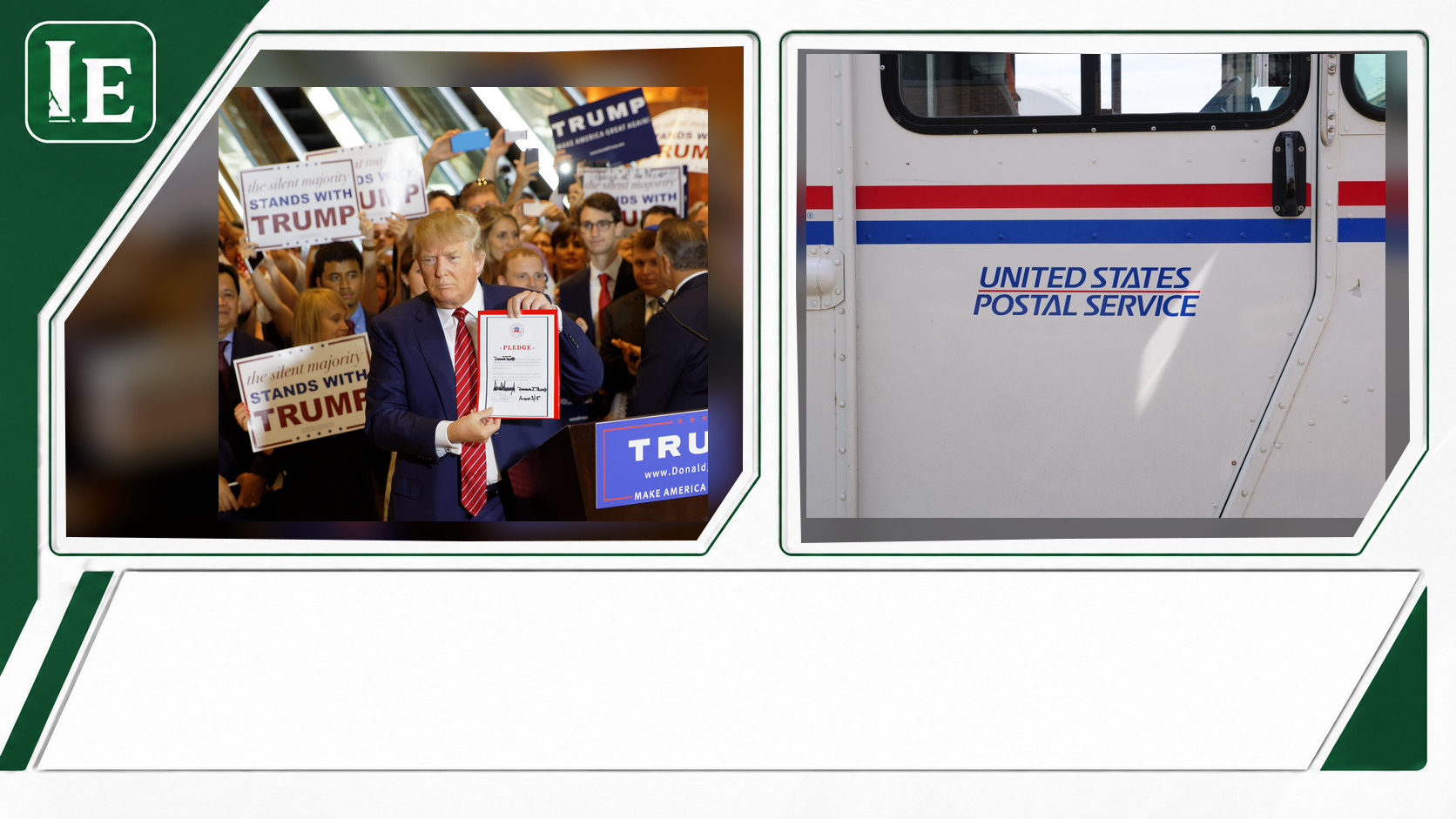
The debate is not only about whether voters can cast ballots by mail, but also about what role a federal postal agency can play in election administration. USPS’s rulemaking shows the boundary between mail delivery standards and the wider voting restrictions sought by the Trump administration.
The United States Postal Service proposed new rules for handling mail-in ballots in federal elections, with comments due July 2, 2026. The USPS proposal is less restrictive than President Donald Trump’s demands on mail-in-ballot procedures because it focuses on postal standards for moving ballots, rather than attempting to remake who may vote by mail or how states run elections.
The difference matters now because election mail has become a major front in the national fight over voting access and election security. USPS can set standards for mail it handles, but its authority does not erase the central role that states play in setting ballot rules, voter eligibility requirements and election deadlines.
A postal rule, not election law
The Postal Service’s June proposal would amend the Domestic Mail Manual, the agency’s rulebook for domestic mail, to address the transmission of mail-in or absentee ballots for federal elections. In its notice, published in the Federal Register, USPS said it was seeking uniform standards for ballots mailed to voters and returned by them.

That is a meaningful area of responsibility. Ballots sent through the mail need recognizable mailing formats, usable addressing, proper postage treatment and processing rules that postal workers and election officials can apply consistently.
But those operational decisions are different from deciding whether a voter qualifies for an absentee ballot, when a ballot must be requested, whether a ballot needs a witness or notary, or what deadline determines whether a returned ballot counts. Those questions are generally governed by state law.
The proposal therefore sits in a narrower lane than the political rhetoric around mail voting might suggest. It concerns the path a ballot takes through the postal system, not a federal takeover of state election administration.
How Trump’s demands go further
Trump has repeatedly argued that mail voting needs tougher limits, framing it as a security issue. His administration has pursued an executive order concerning mail-in voting that seeks broader changes than postal handling standards alone.
Reporting summarized by SCOTUSblog says the administration’s order seeks to restrict mail ballots and create state-by-state lists of citizens to help determine voting eligibility. The Postal Service’s ballot-mail rule, by contrast, concerns standards for federal election mail.
That distinction explains why the USPS action can be described as less restrictive. A uniform rule for how election mail is identified and processed may affect the reliability and visibility of ballots in transit. It does not, on its face, impose a nationwide ban or establish a new national eligibility test for voting by mail.
Supporters of tighter federal rules argue that clearer standards, stronger verification and more complete voter records can improve confidence in elections. Critics counter that expanding federal control could burden eligible voters and intrude on state authority over elections. The Postal Service’s more limited approach does not resolve that larger dispute.
Uniformity can still change outcomes
“Less restrictive” does not mean inconsequential. Small postal rules can matter greatly during an election, especially when voters are close to a request deadline or a state’s return deadline.
Federal election mail moves through a system shared by local election offices, voters, commercial mailers and USPS facilities. A mismatch in envelope design, address quality, labeling or processing expectations can create delays, confusion or ballots that reach election officials later than voters anticipated.
Uniform standards could help election administrators plan their mailings and help the Postal Service more readily recognize ballot mail in its network. Supporters of the rule have said clearer identification of federal ballot mail could improve visibility and support election security.
Still, mail processing cannot cure every problem. A ballot may be rejected for reasons unrelated to delivery, including a missing signature, an unsealed envelope, a late postmark under state law, or a voter failing to meet a state-specific requirement. Postal standards and ballot-counting rules are connected, but they are not the same thing.
The proposal’s unusual timeline
The June 2 Federal Register notice was explicitly labeled a proposed rule, not a final regulation. USPS accepted written public comments through July 2, 2026, giving election officials, voting-rights groups, postal stakeholders and members of the public a chance to challenge or support the plan.
That public-comment process matters because a proposal can change before it becomes final. Agencies must consider the issues raised in comments and explain the reasoning behind a final rule, even though they are not required to adopt every suggested revision.
A later Federal Register document describes a final rule, while current legal coverage has characterized the Postal Service’s plan as finalized. That means readers should distinguish the original proposal from whatever final language USPS ultimately adopted. A proposal’s summary is not necessarily a complete guide to the final rule’s requirements.
The available reporting also points to a significant limitation: USPS said it would not take action to implement the rule specifically for the 2026 election unless the Supreme Court rules in the administration’s favor in the related dispute over Trump’s executive order.
Supreme Court action may decide reach
The Trump administration asked the Supreme Court on July 27 to allow full implementation of the executive order on mail-in voting while litigation continues. According to SCOTUSblog, the request had been fully briefed by early August, leaving the timing and scope of any court action uncertain.
That case could determine whether the administration may press ahead with its broader approach. It could also shape how much practical force the Postal Service’s rule has in the 2026 cycle.
The legal question is bigger than mail logistics. Courts may have to weigh federal executive authority, Congress’s role, constitutional limits and the states’ longstanding power to administer elections. The outcome could affect not only ballot envelopes and postal procedures, but also the line between federal policy and state election control.
What voters and officials should watch
For voters, the immediate practical advice remains straightforward: follow instructions from state and local election officials, request ballots early where applicable, complete every required field, and return ballots with enough time to meet the deadline that applies in that state.
For election administrators, the key questions are more technical: whether final USPS standards alter envelope specifications, mailing practices, tracking or coordination with local postal facilities. Those details can determine whether a rule improves consistency or adds work during an already compressed election calendar.
- Watch the final regulatory text: It will define what USPS actually requires, rather than what the initial proposal contemplated.
- Watch the Supreme Court: Its decision could affect whether any election-specific implementation occurs in 2026.
- Watch state guidance: State deadlines and ballot-validation rules still govern whether an individual ballot is accepted.
The central takeaway is that USPS is addressing the handling of federal ballot mail, while Trump’s demands reach into the broader rules of mail voting and voter eligibility. The two efforts overlap politically, but they operate at very different levels of the election system.
Leave a Reply