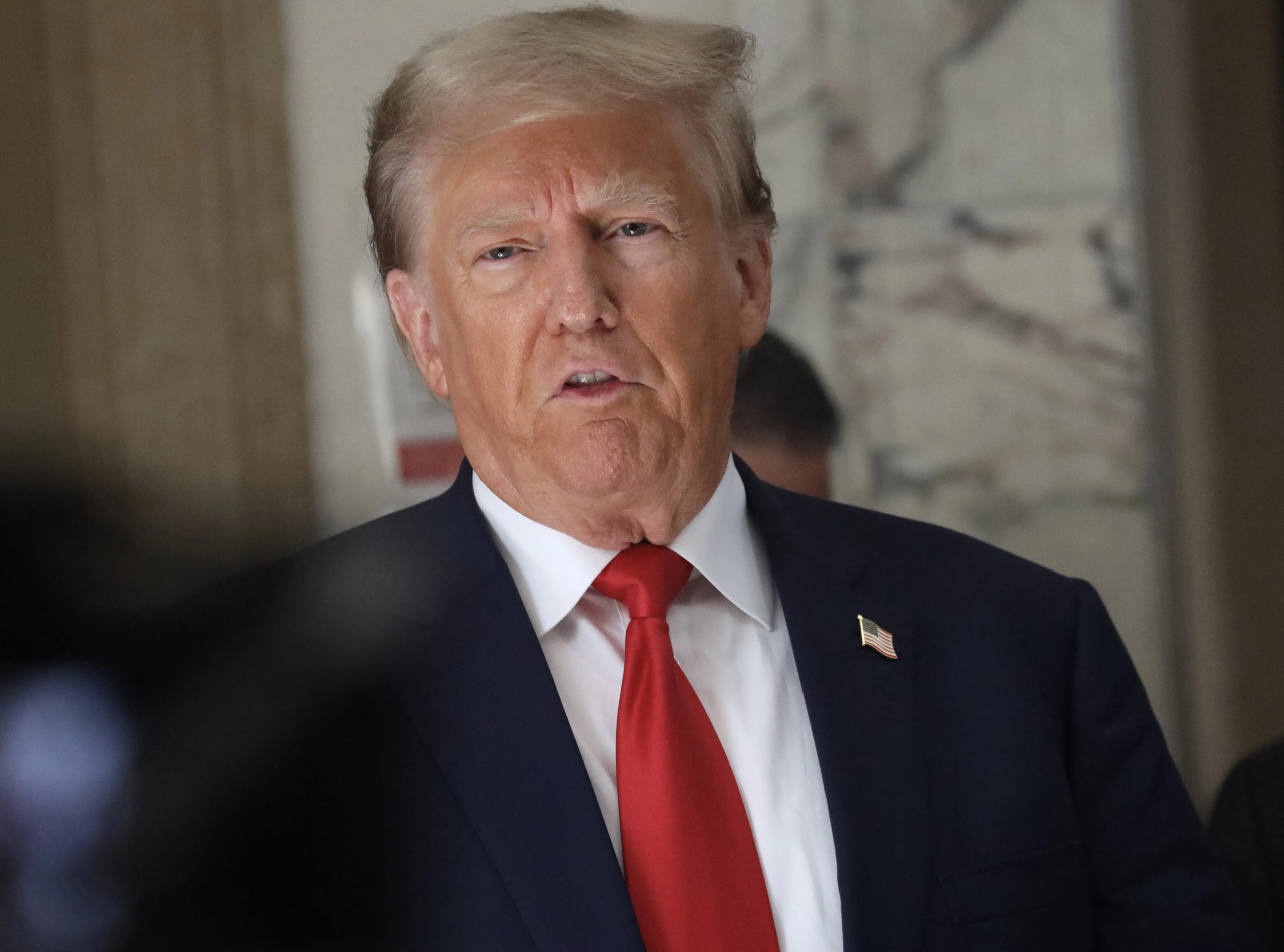
The gap between Trump’s rate demand and market pricing shows how inflation concerns, Fed independence and household borrowing costs are colliding ahead of the next decision.
Trump said the United States should have the world’s lowest interest rates. On Monday, Donald Trump called on the Federal Reserve to lower interest rates, but prediction markets are not pricing in a near-term Federal Reserve cut. Fed cut odds fall below 1%, according to market figures cited by Benzinga, putting traders sharply at odds with Trump’s preferred path.
The divide matters because the Fed’s next move can ripple through mortgages, credit cards, stocks and business financing. Reuters reported that Trump made the comments while urging the Fed to cut, even as markets pointed toward either no change or a possible hike.
Markets see almost no cut
The clearest signal from the cited prediction-market data is that traders are not treating Trump’s call as the likely outcome.
According to Benzinga, Polymarket traders put the odds of a July rate hike at 21%, while no change stood at 79%. The odds of a cut had dropped below 1%, making a near-term reduction a long-shot scenario rather than the market’s central expectation.
Prediction markets are not Federal Reserve guidance. They are prices formed by traders who are putting money behind expected outcomes. They can miss, but they offer a snapshot of where sentiment is clustering before a policy decision.
In this case, that clustering is not around a fast pivot to cheaper money. It is around the Fed holding its line, with some traders also weighing the possibility that rates could move higher.
Trump wants cheaper money
Trump has repeatedly favored lower interest rates, arguing that cheaper borrowing can support growth, financial markets and consumer confidence. His latest statement sharpened that position by saying the U.S. should have the lowest interest rate in the world.
The political appeal is easy to understand. Lower rates can reduce financing costs for households, companies and the government. They can also support stocks by making future earnings look more attractive and pushing investors toward riskier assets.
But central banks do not set rates simply by asking what would help borrowers most in the moment. The Fed’s mandate is focused on maximum employment and stable prices.
If inflation remains too high, cutting rates too early can make the inflation fight harder by loosening financial conditions and encouraging more borrowing. That is why Trump’s demand also raises the familiar question of how publicly the president should pressure an institution expected to make decisions based on economic conditions.
Why the Fed may hold
Benzinga reported that the Fed had kept its target range at 3.50% to 3.75% since December, including at Warsh’s first meeting in June. That range is nowhere near the lowest in the world, but it reflects an effort to balance inflation risk against signs of economic slowing.
The case for staying put is straightforward: if inflation is still sticky, policymakers may not want to signal victory too early. A premature cut could ease financial conditions before inflation is fully under control.
The case for a hike is more contested, but it has not disappeared. Benzinga cited Dallas Fed President Lorie Logan as saying conditions called for modestly higher rates. Cleveland Fed President Beth Hammack said inflation was too high while the labor market was near full employment.
That leaves the Fed in a politically uncomfortable position. Holding steady would disappoint Trump’s call for lower borrowing costs. Hiking would go even further against that pressure and could anger borrowers and investors hoping the next move would be down.
Wall Street prices added risk
Prediction markets were not the only signal pointing away from a quick cut. Benzinga reported that interest-rate swaps implied roughly a 40% chance of a hike as of Monday, citing Bloomberg.
That figure was more aggressive than Polymarket’s 21% hike probability. The difference matters because prediction markets and derivatives markets may reflect different groups of participants, time horizons and risk assumptions.
Citadel Securities, according to Benzinga, expected Warsh not to follow the president’s wishes and called for a quarter-point increase on Wednesday. Its macro strategist Frank Flight argued that such a move would reinforce a pledge on price stability and mark a break from the forward-guidance era.
That was not the consensus in the Polymarket data cited by Benzinga. No change remained the largest outcome there. Still, the fact that hike odds were visible at all shows how distant the debate was from Trump’s call for the world’s lowest rates.
Borrowers already feel pressure
For households, the dispute is not limited to Washington or trading screens. Interest-rate expectations feed into mortgages, auto loans, credit cards and business financing.
Even when the Fed leaves its target rate unchanged, market rates can move as investors anticipate what the central bank may do next. Benzinga cited Cato Institute data showing the 2-year Treasury yield had risen 62 basis points and the 30-year mortgage rate had climbed 45 basis points since December, even as the Fed’s target rate stayed flat.
That means financial conditions can tighten before policymakers officially change rates. Housing is often one of the first places consumers feel it, because higher mortgage rates can reduce affordability, weaken refinancing demand and limit the pool of qualified buyers.
Benzinga pointed to Rocket Companies and D.R. Horton as examples of businesses exposed to rate-sensitive pressures. It also noted potential pressure on the Invesco QQQ Trust, which tracks a tech-heavy Nasdaq benchmark, because higher rates can weigh on high-growth companies by increasing the discount applied to future earnings.
The lowest rate idea has limits
Trump’s argument frames low rates as a competitive advantage: if other countries can borrow cheaply, why shouldn’t the United States?
The complication is that interest rates are not a global scoreboard. Countries differ in inflation, currencies, debt profiles, demographic pressures and central-bank mandates. Very low rates can signal favorable conditions in one economy and weakness or stagnation in another.
The dollar also matters. U.S. rates help anchor global capital flows. If American rates were pushed sharply lower while inflation remained a concern, investors could demand compensation elsewhere, potentially weakening confidence in U.S. assets.
That does not mean rates must stay high indefinitely. It means the path lower usually needs evidence, such as cooling inflation, a softer labor market or financial stress serious enough to justify easier policy.
What remains unsettled
The immediate question is whether the Fed holds, hikes or surprises markets with a cut. Based on the prediction-market figures cited by Benzinga, a cut was barely priced. The live contest appeared to be between no change and a possible increase.
Another unresolved issue is how Warsh and other Fed officials communicate the decision. Benzinga noted criticism from Governor Christopher Waller over limited guidance, citing a Wall Street Journal report. Less guidance can leave markets guessing and make each Fed meeting more volatile.
The political pressure is unlikely to disappear. If the Fed resists Trump now, he can continue arguing that high rates are holding back growth. If the Fed eventually cuts, supporters may portray that as validation of his pressure, even if policymakers cite inflation data instead.
For now, the message from prediction markets is clear: Trump has publicly called for the world’s lowest U.S. interest rates, but traders do not see the Federal Reserve delivering that outcome quickly.
Leave a Reply