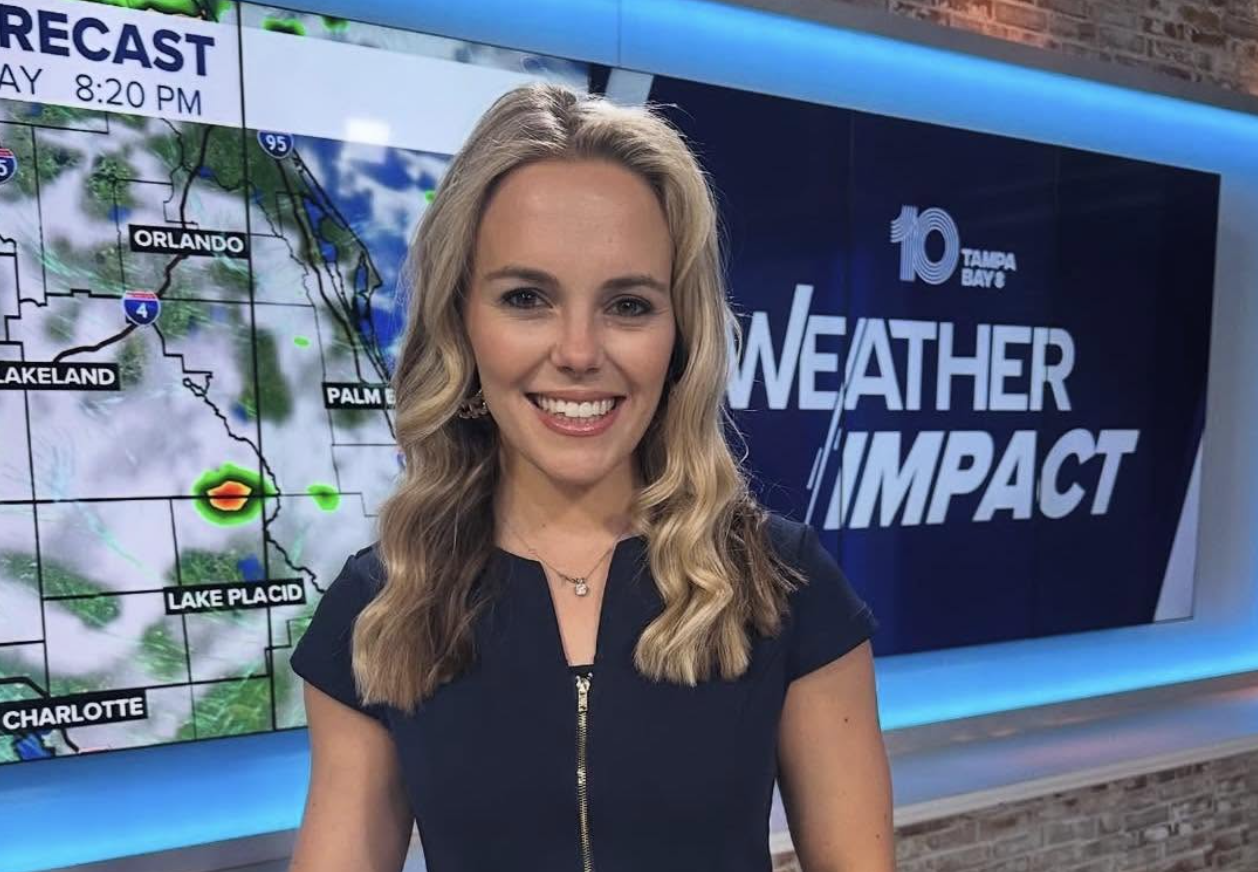
A routine on-air segment became a major social-media moment after viewers fixated on Courteney Jacobazzi’s dress and animated delivery. The response highlights the uneasy gap between a meteorologist’s work and the way viral clips are often consumed.
A Tampa meteorologist’s weather segment drew millions of views after X users reacted to the meteorologist’s appearance. The meteorologist, Courteney Jacobazzi of 10 Tampa Bay, was wearing a form-fitting cream dress in the widely shared clip, and the online attention quickly moved beyond the forecast itself.
According to reporting by Hip Hop Vibe, a 39-second video of Jacobazzi attracted more than 3.5 million views on X after it was posted by @DailyLoud. The moment shows how quickly a local TV segment can become national entertainment — and how easily the substance of an on-air report can be eclipsed by comments about the person delivering it.
A routine segment found a huge audience
Jacobazzi’s clip was not built as a viral production. She was in a Tampa Bay studio, using weather graphics and a handheld remote while delivering a local update in an animated, conversational style.
Her expressions and phrases, including “yikes” and “whew,” became part of what viewers circulated. But the post’s comment section concentrated most heavily on her clothes, looks and body rather than the conditions or local information being discussed.
The source report described the segment as covering local conditions and a serious accident. That contrast is central to why the clip has drawn notice: a broadcast item with public-service value was recast online primarily as a reaction video.
View counts do not equal weather interest
The reported 3.5 million-plus views are a striking number for a short local-TV clip. Still, viral reach does not necessarily mean millions of people were seeking a Tampa Bay forecast or engaging with the underlying news.
On X, short video posts often travel because they can be understood without context, sound or location-specific knowledge. A presenter’s delivery, appearance or a provocative caption may prove more shareable than a detailed explanation of weather patterns, traffic disruptions or safety concerns.
That dynamic can make the original purpose of a segment nearly invisible. A local audience may tune in for practical information, while a much broader social audience encounters the clip as a visual moment detached from the station, city and report.
Jacobazzi’s work extends beyond one clip
Jacobazzi is a broadcast meteorologist at 10 Tampa Bay, also known as WTSP. The source report says she holds a National Weather Association Seal of Approval and studied broadcast journalism at the University of Central Florida as well as broadcast meteorology at Mississippi State University.
Her career has included work in Georgia and Florida, and she has publicly discussed tracking severe weather and tropical systems. That role carries particular weight in the Tampa Bay area, where hurricane season, intense heat and frequent thunderstorms can make clear local forecasting consequential.
For meteorologists in Florida, on-camera work is not simply performance. It can include translating fast-changing weather data, communicating risk and helping audiences decide how to respond when conditions become dangerous.
The familiar problem with viral weather clips
There is nothing unusual about broadcasters bringing personality to a forecast. Clear gestures, memorable phrasing and a confident presence can help viewers follow a fast-moving report.
The more complicated issue is the way female meteorologists are routinely reduced online to their appearance. The phrase “weather girl,” often used casually in viral posts, can flatten professional roles that require scientific training, newsroom experience and public-facing judgment.
Some viewers may see the attention as harmless admiration or a boost to a presenter’s visibility. Others argue that comment threads centered on clothes and bodies create a narrower and more demeaning standard for women working on television, especially when their actual reporting receives little notice.
Both realities can exist at once: a broadcaster may gain exposure from a viral clip, while the conversation around that exposure fails to reflect the work that put her on screen.
Local stations face a changing audience
For local stations, social platforms offer an obvious opportunity. A short clip can introduce on-air talent to viewers well outside a traditional broadcast market and bring attention to a station’s reporting.
But the incentives are not always aligned with public-service journalism. The fastest-moving posts are often those that encourage instant reaction, while the most important parts of local coverage may require attention, context and follow-through.
There is no indication that Jacobazzi or 10 Tampa Bay created this particular wave of attention around her outfit. The available reporting identifies a third-party X post as the main driver of its spread.
The takeaway from the episode is straightforward: Courteney Jacobazzi’s Tampa Bay segment reached a huge audience, but much of that audience was responding to an image rather than a forecast. In an era when any local broadcast can be clipped and recirculated, the line between useful reporting and viral spectacle is increasingly thin.
Leave a Reply