
Pence’s warning puts a familiar economic question back in focus: when neighboring countries escalate tariffs, who ultimately absorbs the cost? The immediate dispute involves Washington and Ottawa, but the consequences could reach businesses, shoppers and cross-border supply chains.
Mike Pence said the U.S.-Canada trade fight adds to affordability concerns for the economy, warning that a trade war with Canada could damage American businesses and American consumers. His comments came after 50% U.S. tariffs on roughly $20 billion in Canadian goods took effect Saturday, followed by Canada’s plan for matching 50% tariffs on U.S. exports beginning Sept. 8.
Speaking Sunday on CNN’s State of the Union, the former vice president argued that tariffs are paid in the United States by American businesses and consumers. The clash matters because the two countries are deeply connected trading partners, so a dispute designed to create pressure in negotiations can also create pressure on prices and supply chains.
Pence puts affordability at center
Pence’s core point was direct: a trade conflict is poorly timed when households are already focused on the cost of everyday life.
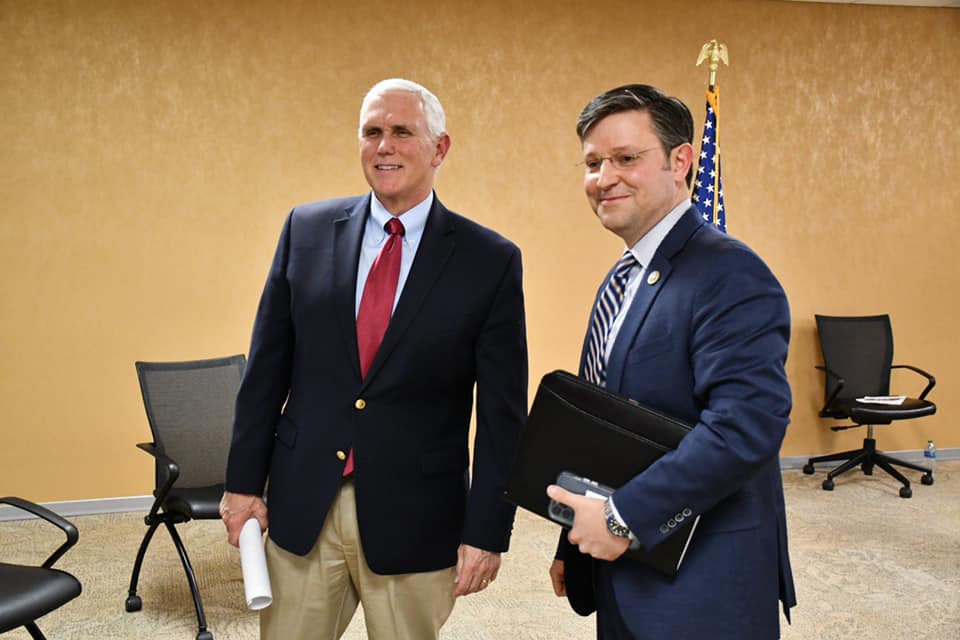
“We hear about the issue of affordability right now,” Pence told CNN, according to The Washington Post. “I think the last thing we need right now, as our economy is getting back on its feet, is a trade war with Canada.”
He expanded that argument in remarks reported by The Hill, saying, “American businesses and American consumers pay American tariffs.” It is a notable critique from a former vice president who served in the first Trump administration and said he was involved in negotiations over the U.S.-Mexico-Canada trade agreement.
Pence did not argue that the United States should avoid difficult trade negotiations. Instead, he urged an approach that separates bargaining from an extended escalation, saying the goal should be to “drive a hard bargain” while pursuing free trade with free nations.
The tariff escalation now underway
The immediate dispute intensified after trade talks between Trump administration officials and the Canadian government broke down late in the week, according to The Hill.
President Donald Trump’s 50% tariffs on about $20 billion worth of Canadian goods took effect Saturday. Canadian Prime Minister Mark Carney then said Canada would impose commensurate 50% tariffs on U.S. goods exported to Canada starting Sept. 8.
That sequence is important because retaliatory tariffs can turn a one-sided import tax into a two-country commercial fight. U.S. companies selling into Canada can face new costs or weaker demand there, while U.S. importers purchasing covered Canadian products can face higher expenses at home.
- For U.S. importers: tariffs can raise the cost of bringing covered Canadian goods into the country.
- For U.S. exporters: Canada’s planned tariffs can make their products more expensive in a major nearby market.
- For households: companies may absorb some costs, seek other suppliers or pass part of the increase on through prices.
Why a Canada dispute hits differently
Trade disputes are not all alike. Canada is not a distant or marginal trading partner; it is tightly integrated with the United States through transport links, manufacturing networks, energy flows and regional commerce.
That integration can make tariffs especially disruptive. A product can cross the border more than once as components are processed, assembled and shipped through North American supply chains. New border costs can therefore affect more than the company making the final sale.
Carney acknowledged the domestic downside of retaliation when announcing Canada’s response. According to The Hill, he said the measures would be taken “reluctantly,” recognizing they could raise costs and reduce choice for Canadians while harming U.S. companies and states that were not looking for a dispute.
That is the economic tension beneath Pence’s warning. Tariffs can be used as leverage, but leverage works partly by creating consequences. The question is whether those consequences force a negotiated outcome quickly enough to outweigh the disruption they cause.
Tariffs are not a simple price switch
Pence’s statement that Americans pay American tariffs reflects the basic mechanics of an import tariff: the U.S. government charges a duty on covered goods entering the country. The immediate payer is generally the importer, not the foreign government.
What happens next varies. An importer may accept a smaller profit margin, a supplier may cut its price, a company may look for a replacement source, or a business may raise prices. In many real-world cases, the burden is spread across those players rather than landing neatly on one of them.
Supporters of tariffs argue that the policy can give U.S. negotiators leverage, encourage domestic production and respond to conduct they see as unfair. They also contend that short-term costs may be justified if a deal delivers more favorable trading terms.
Critics, including Pence in this case, see a particular risk when the target is Canada: any leverage gained against a close economic partner may be offset by higher costs, retaliatory barriers and uncertainty for companies that need predictable cross-border access.
Businesses face an uncertainty problem
Prices are the most visible concern, but uncertainty can be costly in its own right. Companies deciding where to source materials, build inventory or make long-term investments need to know whether a tariff is temporary negotiating pressure or the start of a durable policy shift.
When the answer is unclear, businesses may delay purchases or investments, renegotiate contracts, change suppliers or build more inventory as a precaution. Those adjustments can be difficult for smaller firms with less cash and fewer sourcing options.
The present confrontation also leaves major questions unanswered. It is not clear whether the two governments have a defined path back to negotiations, whether the tariffs will be narrowed or broadened, or how long the planned Canadian response would remain in place.
Pence said he hoped the “hot rhetoric” between Trump and Carney would give way to substantive talks. That distinction will matter: a brief dispute resolved by agreement has different economic effects from a prolonged cycle of tariffs and retaliation.
The household test for trade policy
The political argument over tariffs often centers on strength, sovereignty and negotiating power. Pence is emphasizing a more immediate test: whether families and employers experience the policy as another cost at a time when affordability remains a sensitive issue.
For American consumers, the effect will depend on which goods are covered, how much companies can shift sourcing and how long the measures last. For businesses, the focus will be on input costs, Canadian market access and whether supply arrangements must change.
The U.S.-Canada trade fight is therefore more than a diplomatic clash. It is a live test of whether an aggressive tariff strategy produces a faster settlement—or whether the economic costs Pence warned about become part of the dispute itself.
Leave a Reply